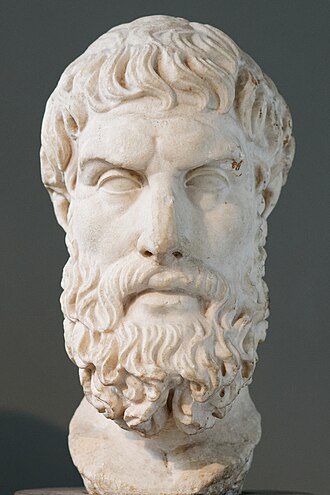
Born on the island of Samos around 341 BCE, Epicurus founded in Athens, in 307 BCE, the school known as the Garden (Kepos) — a community of friends that, remarkably for its time, welcomed women and slaves. He lived simply and in seclusion, and died around 270 BCE, facing with serenity the pains of a kidney ailment. His philosophy, heir to Socrates in the ideal of philosophy as an art of living, has a therapeutic aim: to free the human being from what disturbs their peace.
In physics, Epicurus revives the atomism of Democritus: everything is made of atoms and void. But he adds the clinamen, the spontaneous, minimal swerve of atoms in their fall — a device that breaks strict determinism and makes room for freedom. The gods exist, but, perfectly happy, they do not concern themselves with human affairs: there is therefore no reason to fear them.
In ethics, the end of life is pleasure — but understood as the absence of pain in the body (aponia) and tranquility of the soul (ataraxia), not as the pursuit of intense gratifications. Hence the importance of distinguishing natural and necessary desires from vain ones, and of cultivating simple goods and friendship, which Epicurus regarded as the greatest of goods. His message is condensed in the tetrapharmakos (the “fourfold cure”): do not fear the gods, do not fear death — for “while we exist, death is not present; and when death comes, we no longer exist” — remember that the good is easy to attain and that pain is bearable. His influence reaches Lucretius, who cast it into a poem, and echoes in modern thought about pleasure and happiness.
Key Concepts
- Ataraxia (tranquility) + aponia (absence of pain) = happiness
- Negative hedonism: pleasure = absence of pain (not excitement)
- Clinamen: spontaneous deviation of atoms → freedom
- Tetrapharmakos: do not fear gods, do not fear death, the good is easy, the bad is bearable
- Friendship as the greatest social good
- Three types of desires: natural-necessary / natural-non-necessary / vain
Influenced by
- Democritus — atomism
- Socrates — philosophy as an art of living
- Diogenes of Sinope — simplicity
Influenced
- Lucretius — De Rerum Natura (poetic systematization)
- Modern liberal thought (Mill, Bentham — pleasure as criterion)
- Nietzsche — love of life; anti-asceticism
Works
Letter to Menoeceus (ethics); Letter to Herodotus (physics); Principal Doctrines. Sources: Diogenes Laërtius, Lives, X.
See also
Hellenistic Philosophy