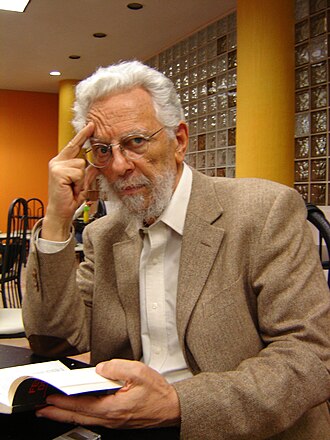
Born in Mendoza, Argentina, in 1934, Enrique Dussel had a cosmopolitan formation — he studied in Argentina, Spain, France, and Germany, and also researched the history of the Church in Latin America. After a bomb attack on his home, he went into exile in Mexico in 1975, where he became a naturalized citizen and lived until his death, in 2023. He is the leading name of Latin American Liberation Philosophy and a central reference of decolonial thought.
His philosophy begins from an indictment: European Modernity, which presents itself as universal, was in fact born in 1492, with the conquest of America — not a “discovery” but the “concealment of the Other,” the beginning of a colonial domination that modern reason itself masks. Against this Eurocentrism, Dussel proposes to philosophize from exteriority: the starting point is not the European “I think” but the excluded Other — the poor, the indigenous, the woman, the colonized.
To this turn he gives the name analectics (in contrast to Hegelian dialectics, which tends to absorb the Other into the Same) and develops it into a vast ethics of liberation, in critical dialogue with Habermas and discourse ethics, taking concrete human life as its ultimate criterion. His proposal of a transmodernity — not anti-modern but critically incorporating Modernity from the perspective of silenced cultures — influenced Paulo Freire, Liberation Theology, and the decolonial studies of Mignolo and Quijano.
Key Concepts
- Philosophy of Liberation (Filosofía de la liberación, 1977): philosophy committed to transforming conditions of exclusion, starting from the Other
- Analectics: recognition of the irreducible exteriority of the Other, beyond Hegelian dialectics which absorbs the Other into the Same
- Concealment of Modernity (1492: El encubrimiento del Otro, 1992): 1492 is the inaugural moment of Modernity as colonial domination, not a simple “discovery”
- Transmodernity: critical incorporation of Modernity’s achievements from the perspective of excluded cultures — supersession through inclusion
- Ethics of Liberation (Ética de la liberación, 1998): ethics grounded in human life as fundamental criterion, in critical dialogue with Apel and Habermas
Influenced by
- Lévinas — philosophy of alterity and ethics of the Other
- Heidegger — phenomenology (incorporated critically)
- Marx — critique of political economy
- Karl-Otto Apel and Habermas — discourse ethics (critical dialogue)
- Leopoldo Zea and Augusto Salazar Bondy — Latin American philosophical debate
Influenced
- Decolonial thought (Mignolo, Maldonado-Torres)
- Liberation Theology
- Contemporary Latin American critical theories
Works
Filosofía de la liberación (1977); El encubrimiento del Otro (1992); Ética de la liberación en la edad de la globalización y de la exclusión (1998); Política de la liberación (2 vols., 2007–2009); Filosofías del Sur (2016).
See also
Latin American Philosophy Paulo Freire Leopoldo Zea