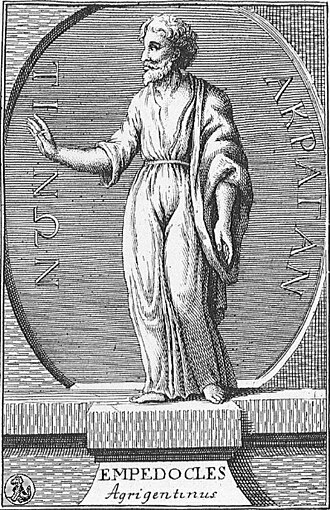
Empedocles (c. 494–434 BCE) was one of the most extraordinary figures of Greek philosophy: at once philosopher, physician, poet, orator, and political leader in his native city of Akragas, in Sicily. A legendary aura formed around him — he presented himself almost as a god among men, and tradition holds that he leapt into the crater of Mount Etna to confirm his divinity. He expounded his ideas in two poems, On Nature and Purifications.
His response to the challenge left by Parmenides — that being can neither come to be nor perish — was pluralism: instead of a single principle, he proposed four eternal and immutable “roots,” fire, air, water, and earth. Nothing truly comes to be or passes away; what we call generation and corruption is merely the mixture and separation of these four elements. This theory of the four elements would dominate Western science for more than two thousand years.
What combines and separates the roots are two great cosmic forces: Love (Philia), which unites, and Strife (Neikos), which separates. The cosmos passes through an eternal cycle between full unity, under the dominion of Love, and total dispersal, under the dominion of Strife. To this physics Empedocles joined a religious dimension, inherited from Pythagoreanism: belief in the transmigration of souls and the need for purification. His ideas influenced Aristotle, the Hippocratic medicine of the four humors, and the long alchemical tradition.
Key Concepts
- Four roots (elements): Fire, Water, Earth and Air are the four eternal and immutable elements; all reality is a combination and separation of these
- Love and Strife (Philia and Neikos): the two cosmic forces — Love unites the elements, Strife separates them; the cosmos oscillates between total unity (predominance of Love) and total dispersal (predominance of Strife)
- Cosmic cycle: the cosmos passes through four phases — perfect Sphere (pure Love) → progressive separation (Strife grows) → maximum dispersal → reunification (Love grows again)
- Theory of perception: we perceive because the pores of sense organs capture effluences from things — like knows like (“we know earth with earth, water with water”)
- Metempsychosis: the soul transmigrates through diverse forms of life as purification; Empedocles claimed to have been a fish, bird, boy and girl in previous lives
Influenced by
- Parmenides — being cannot be created nor destroyed (applies to the elements)
- Pythagoras — metempsychosis and purity of the soul
- Heraclitus — opposition and conflict as motor
Influenced
- Aristotle — adopted and developed the theory of the four elements
- Hippocratic medicine — four humors based on the elements
- Plato — Timaeus uses the elements
- Alchemy and pre-modern chemistry (until Lavoisier)
Works
On Nature (poem); Purifications (poem); preserved fragments.
See also
Pre-Socratics and Sophists