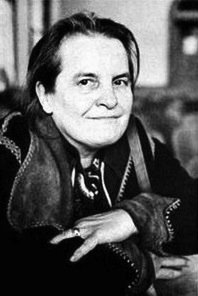
Gertrude Elizabeth Margaret Anscombe (1919–2001) was one of the most original analytic philosophers of the twentieth century. A student and close friend of Ludwig Wittgenstein at Cambridge, she became one of his literary executors and translated his Philosophical Investigations (1953) into English — a rendering that remains canonical. A devout Catholic, she fused the rigour of the analytic tradition with an Aristotelian-Thomist sensibility that shaped her entire body of work. Her monograph Intention (1957) is widely regarded as the founding text of contemporary philosophy of action, while her essay “Modern Moral Philosophy” (1958) is commonly identified as the starting point of the virtue ethics revival in the Anglophone world. She taught at Oxford and, from 1970, held the chair of philosophy at Cambridge once occupied by Wittgenstein.
Key Concepts
- Intentional action under descriptions (Intention, 1957): one and the same action can be described in many ways, and it is intentional only under certain of those descriptions. The decisive test is the question whose answer gives the agent’s reason — the famous “Why?” question applied to action.
- Practical knowledge (Intention, 1957): Anscombe revives the idea that an agent possesses a knowledge of his own action that does not rest on observation (knowledge without observation). Such knowledge is “the cause of what it understands”, reversing the direction of merely contemplative, observational knowledge.
- Critique of the moral “ought” (“Modern Moral Philosophy”, 1958): the modern concepts of “moral obligation” and “moral duty” (the moral ought) are survivals of a law-conception of ethics — inherited from a tradition that presupposes a divine lawgiver — that have outlived that framework. Without the lawgiver, they become expressions with no clear content and ought to be jettisoned.
- Return to virtue (“Modern Moral Philosophy”, 1958): in place of the vocabulary of duty, Anscombe proposes recovering concepts such as justice, courage, and dishonesty, and argues that ethics can only progress once it is preceded by an adequate philosophy of psychology (intention, pleasure, desire, wanting).
- Coinage of “consequentialism” (“Modern Moral Philosophy”, 1958): it was Anscombe who introduced the term consequentialism to designate — and criticise — those ethical theories that assess actions solely by their foreseeable consequences, rejecting absolute prohibitions.
- Doctrine of double effect: she defended the Thomist distinction between what is intended as means or end and what is merely foreseen as a side effect, a distinction central to her opposition to acts such as the killing of the innocent.
Influenced by
- Ludwig Wittgenstein — teacher, friend, and principal philosophical influence
- Aristotle — psychology of action and the ethics of the virtues
- Thomas Aquinas — practical reasoning and the doctrine of double effect
- Frege — through the analytic milieu of Cambridge
Influenced
- Philippa Foot — interlocutor and friend; the virtue ethics revival
- Alasdair MacIntyre — recovery of Aristotelian ethics
- Bernard Williams — critique of the morality of “duty”
- Donald Davidson — philosophy of action (in critical dialogue)
Works
Anscombe’s most influential work is Intention (1957), a short monograph that reoriented the study of action, intention, and practical reasoning. The essay “Modern Moral Philosophy” (1958), published in the journal Philosophy, had an impact wholly disproportionate to its length, redefining the agenda of Anglophone ethics. Her translation of Wittgenstein’s Philosophical Investigations (1953) and the volumes she helped edit from his literary remains were decisive for the reception of his later philosophy. Her many essays — on causation, the first person, perception, and ethics — were gathered in the Collected Philosophical Papers (1981).
See also
Wittgenstein, Philippa Foot, Alasdair MacIntyre