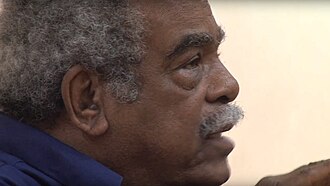
Édouard Glissant (21 September 1928, Sainte-Marie, Martinique — 3 February 2011, Paris) was a poet, novelist, essayist, and philosopher, one of the major figures of Caribbean thought and of French-language postcolonial theory. A pupil at the Lycée Schœlcher, where Aimé Césaire was among his teachers, he went on to study philosophy at the Sorbonne and ethnography at the Musée de l’Homme in Paris. He received the Prix Renaudot in 1958 for his novel La Lézarde. His entire body of work — spanning poetry, fiction, and philosophy — turns on a single intuition: that identity is grounded not in a single root but in an ever-open relation with the other. Against the philosophies of purity and origin, Glissant thought the Caribbean — land of the plantation, of uprooting and forced mixture — as the laboratory of a humanity to come.
Key Concepts
- Antillanity (Antillanité): while respecting Césaire’s Négritude, Glissant judged it still bound to an essential African origin. He proposes, instead, to affirm the specifically Caribbean condition — a place made of encounters, of multiple roots, and of the traumatic experience of the plantation — rather than referring identity back to an idealized Africa.
- Creolization (créolisation): the unpredictable, creative process by which cultures brought into contact produce something genuinely new, irreducible to the sum of its components. Glissant distinguishes creolization from mere métissage (which would presuppose pure origins to be combined) and extends it to the whole planet: the entire world, today, “is creolizing.”
- Poetics of Relation (Poétique de la Relation, 1990): to root-identity (identité-racine) — single, fixed, exclusive, the model that historically served to legitimate conquest — Glissant opposes rhizome-identity (identité-rhizome, a notion he borrows from Deleuze and Guattari): an identity that exists only in relation to the other, open, multiple, with no center or sovereign origin.
- The right to opacity (le droit à l’opacité): against the Western demand for “transparency” — to understand, classify, and reduce the other to one’s own categories — Glissant claims the right of every person and culture to remain opaque, irreducible, not fully decipherable. Already formulated in Caribbean Discourse (1981) and taken up again in the Poetics of Relation, it is an ethical principle: I can live with the other without having to dissolve them into what I understand of them.
- The Whole-World (le Tout-Monde) and the Diverse (le Divers): the totality of the planet’s cultures in unpredictable interrelation (the chaos-monde); Glissant celebrates the Diverse — a legacy he acknowledges from Victor Segalen — against the uniformity of the Same.
Relation to créolité
The manifesto Éloge de la créolité (In Praise of Creoleness, 1989), by Jean Bernabé, Patrick Chamoiseau, and Raphaël Confiant, drew openly on Glissant. He, however, kept a critical distance: he preferred creolization — an open, unfinished process — to creoleness (créolité), which, in his view, risked crystallizing into a new fixed essence or identity, betraying the very openness he sought to think.
Influenced by
- Aimé Césaire — his teacher, by continuity and by critical distance from Négritude
- Deleuze and Félix Guattari — the rhizome, multiplicity
- William Faulkner — the saga of the South and the “impossible land” (Glissant devoted Faulkner, Mississippi, 1996, to him)
- Victor Segalen — the Diverse and the “aesthetics of the diverse”
- Saint-John Perse — the poetics of the world
Influenced
- Caribbean and postcolonial studies
- The writers of créolité (Chamoiseau, Confiant)
- Decolonial thought and theories of diaspora
- Contemporary art and debates on cultural globalization
Works
La Lézarde (novel, 1958, Prix Renaudot); Le Discours antillais (Caribbean Discourse, 1981); Poétique de la Relation (Poetics of Relation, 1990); Faulkner, Mississippi (1996); Traité du Tout-Monde (1997); Philosophie de la Relation (2009).
See also
Aimé Césaire, Frantz Fanon, Homi Bhabha