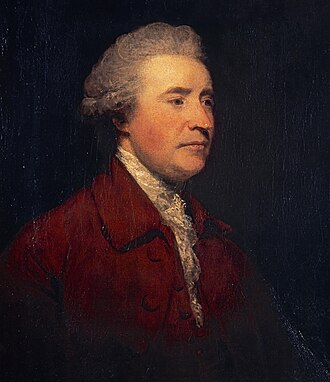
Edmund Burke was born in Dublin on 12 January 1729 and died in Beaconsfield, England, on 9 July 1797. Educated at Trinity College Dublin and trained in law in London, he became a writer and, from 1766, a Whig member of the House of Commons, where he sat for nearly three decades. His work is not a philosophical system but a body of essays, speeches, and pamphlets occasioned by concrete political questions: the relation of Crown and Parliament, the conflict with the American colonies, the East India Company’s rule in India, and the French Revolution. His contribution to political philosophy lies precisely in this interplay of principle and circumstance.
Burke began with A Vindication of Natural Society (1756) and A Philosophical Enquiry into the Origin of Our Ideas of the Sublime and Beautiful (1757), a work of aesthetics that influenced Kant and Romanticism. In politics he argued for conciliation with the American colonists (Speech on Conciliation with America, 1775) and led the impeachment of Warren Hastings (begun 1788), charging the former Governor-General of India with abuse of power. His most influential text, Reflections on the Revolution in France (1790), written in reply to a sermon by Richard Price, became the reference work of the conservative tradition.
Key Concepts
- Critique of abstract rationalism — Burke rejects the idea that political order can be deduced from universal rights and principles and applied all at once; politics requires prudence, attention to circumstance, and accumulated knowledge.
- Prescription and prejudice — inherited institutions embody a collective wisdom tested by time; what Burke calls “prejudice” names moral dispositions and habits that sustain social life, not mere irrationality.
- Society as a partnership across generations — in the Reflections, political society is a partnership joining the living, the dead, and those yet to be born, which limits each generation’s right to remake the social order at will.
- Gradual reform — legitimate change preserves what can be preserved (“a state without the means of some change is without the means of its conservation”); Burke distinguishes reform from revolutionary rupture.
- The little platoons — attachment to local groups (family, neighborhood, intermediate bodies) is, according to the Reflections, the germ of wider public affections, an idea later taken up by Tocqueville and the tradition of social pluralism.
- Representation — in his speech to the electors of Bristol (1774), he distinguishes the representative, who must exercise independent judgment for the common good, from a mere delegate of local interests.
- Critique of abstract rights — Burke does not deny rights but contests that metaphysical “rights of man” can be invoked without institutional mediation; real rights, he holds, are those arising from a historically formed constitution.
Interpretations and Criticism
Burke has been read in divergent ways: as a Whig liberal who defended the Glorious Revolution and the American cause, and as the father of conservatism. Contemporary critics such as Thomas Paine (Rights of Man, 1791) and Mary Wollstonecraft (A Vindication of the Rights of Men, 1790) answered the Reflections directly, accusing him of sanctifying privilege and underrating the injustice of inherited orders. Leo Strauss, in Natural Right and History, discussed Burke as a figure in a historicist reaction against modern natural right, a theme still debated.
Influenced by
- Cicero — a model of oratory and recurring reference, including in the Hastings trial, often compared to Cicero’s prosecution of Verres
- Montesquieu — attention to the variety of historical circumstances shaping constitutions
- Locke — the Whig inheritance of the Revolution of 1688
Influenced
- Alexis de Tocqueville — affinity in valuing intermediate bodies, though Tocqueville is not considered a direct disciple
- Friedrich Hayek — who found in Burke and the Whig tradition a source for his defense of evolved orders, even while rejecting the conservative label in “Why I Am Not a Conservative”
- The twentieth-century Anglo-American conservative tradition, including Michael Oakeshott and Russell Kirk
Works
A Vindication of Natural Society (1756); A Philosophical Enquiry into the Origin of Our Ideas of the Sublime and Beautiful (1757); Thoughts on the Cause of the Present Discontents (1770); Speech on Conciliation with America (1775); Reflections on the Revolution in France (1790); Letter to a Noble Lord (1796).
See also
Alexis de Tocqueville, Leo Strauss, Friedrich Hayek, Montesquieu, Locke, Rousseau