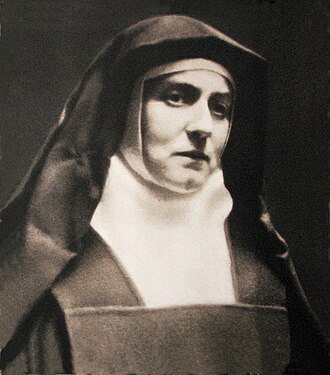
Edith Stein was born in Breslau (today Wrocław) on 12 October 1891 into a Jewish family and died in Auschwitz-Birkenau on 9 August 1942. She studied in Göttingen from 1913, where she joined the circle of Edmund Husserl, and took her doctorate with him at Freiburg in 1916 with the thesis Zum Problem der Einfühlung (published in 1917). She served as Husserl’s assistant and prepared manuscripts for publication, among them the lectures on the inner consciousness of time. Baptized into the Catholic Church on 1 January 1922, she taught at Speyer and then at the Institute for Scientific Pedagogy in Münster, until the Nazi racial laws ended her teaching in 1933. In October of that year she entered the Carmel of Cologne, taking the name Teresa Benedicta of the Cross, and in 1938 she was transferred to the convent at Echt in the Netherlands. Arrested by the Gestapo on 2 August 1942, after the Dutch bishops’ condemnation of Nazi antisemitism, she was deported with her sister Rosa and died in Auschwitz-Birkenau. She was beatified on 1 May 1987 and canonized by John Paul II on 11 October 1998; the decision prompted debate over how her death should be understood, whether as Christian martyrdom or as that of a Jewish victim of Nazi persecution.
Key Concepts
- Empathy (Einfühlung) — in her thesis she analyzes empathy as the specific act in which another person’s experience is given to consciousness as someone else’s experience, not as one’s own; she engages Theodor Lipps, Max Scheler and Husserl, and her analysis is a central reference of the phenomenology of intersubjectivity.
- The human person — in Beiträge zur philosophischen Begründung der Psychologie und der Geisteswissenschaften (1922) and in later texts on the constitution of the person (collected in Der Aufbau der menschlichen Person), she describes the person as a unity of body, psyche and spirit.
- Community and state — in Eine Untersuchung über den Staat (1925), she applies the phenomenological method to the analysis of society, community and the state.
- Finite and eternal being — in Endliches und ewiges Sein (completed in 1937; published in 1950), she seeks to confront the ontology of Thomas Aquinas with Husserl’s phenomenology and with the existential analytic of Martin Heidegger, whose philosophy of existence she examines in an appendix.
- Science of the cross — in Kreuzeswissenschaft (an unfinished work, published in 1950), she studies the mystical theology of John of the Cross.
Influenced by
- Edmund Husserl, from whom she received the phenomenological method and whose assistant she was
- Adolf Reinach, a philosopher of the Göttingen circle
- Max Scheler, with whom she engages in her analysis of empathy
- Thomas Aquinas, whose Quaestiones disputatae de veritate she translated into German (1931–1932)
- Teresa of Ávila and John of the Cross, in the spiritual dimension of her work
Influenced
- The phenomenology of empathy and intersubjectivity, in which Zum Problem der Einfühlung is still discussed
- The philosophy of the person and Catholic-inspired philosophical anthropology
- Reflection on education and on the condition of women, drawing on her lectures and essays
- She was named by John Paul II among Christian thinkers in the encyclical Fides et ratio (1998) and proclaimed co-patroness of Europe in 1999
Works
Zum Problem der Einfühlung (1917); Beiträge zur philosophischen Begründung der Psychologie und der Geisteswissenschaften (1922); Eine Untersuchung über den Staat (1925); Potenz und Akt (written in 1931; published in 1998); Endliches und ewiges Sein (1950); Kreuzeswissenschaft (1950); Aus dem Leben einer jüdischen Familie (written from 1933; published posthumously).
See also
Edmund Husserl, Max Scheler, Martin Heidegger, Thomas Aquinas, Jacques Maritain, Simone Weil