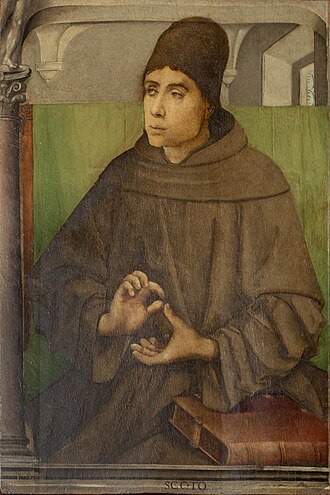
Born around 1266 in Duns, Scotland, John Duns Scotus entered the Franciscan order and taught at Oxford, Paris, and Cologne, where he died prematurely in 1308. The subtlety and rigor of his distinctions earned him the title of “Subtle Doctor.” Alongside Thomas Aquinas and William of Ockham, he is one of the great names of high Scholasticism — and the principal Franciscan counterpoint to Thomism.
His most characteristic metaphysical thesis is the univocity of being. Against Thomas Aquinas, who held that “being” is attributed to God and creatures only by analogy, Scotus maintains that the concept of being has a univocal sense, the same for the Creator and the creature — without which, he argues, no knowledge of God from the world would be possible. It is the most universal and indeterminate concept of all.
Another famous contribution is haecceity (its “thisness”): that which makes each being not merely an instance of a species but this unique and unrepeatable individual — a philosophical valorization of singularity. In the order of action, Scotus is a voluntarist: he gives primacy to the will over the intellect, in both God and man. A defender of the ontological argument of Anselm of Canterbury (which he reformulated with modal rigor) and of the Immaculate Conception, his influence marked Franciscan thought and reached as far as Heidegger, who devoted his habilitation thesis to him.
Key Concepts
- Univocity of being: the concept of “being” applies univocally to God and creatures (against Thomas who defends analogy); being is the most universal and least determined of concepts
- Formal distinction: beyond real distinction and distinction of reason, there is a formal distinction in re — between properties of the same being (e.g.: intellect and will in God)
- Haecceity: the principle of individuation of each being — its “thisness,” what makes it this concrete individual
- Voluntarism: the will has primacy over the intellect; moral law depends primarily on the will of God
- Defends the ontological argument of Anselm of Canterbury
Influenced by
- Avicenna — being and essence
- Anselm of Canterbury — ontological argument
- Augustine — illumination, will
Influenced
- William of Ockham — disciple who radicalized nominalism
- Modern Franciscan thought
- Heidegger — habilitation thesis on Scotus and the categories
Works
Ordinatio (Opus Oxoniense); Treatise on the First Principle.
See also
Medieval Philosophy