Note on romanisation: Japanese names are given in Hepburn romanisation, with the original characters in parentheses on first occurrence. Macrons (ō, ū) indicate long vowels.
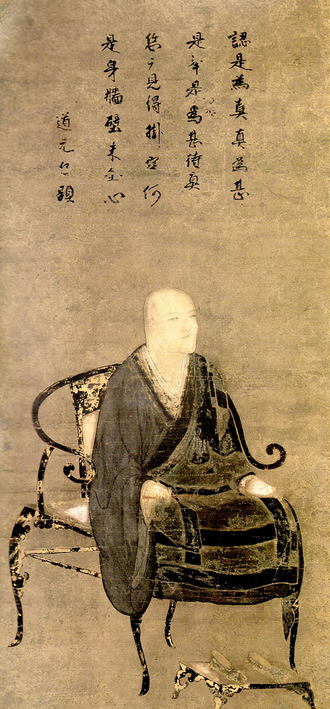
Dōgen Kigen (道元希玄), also known as Dōgen Zenji (道元禅師, “Zen Master Dōgen”), is the Japanese founder of the Sōtō (曹洞) school of Zen. He took monastic vows in his teens on Mount Hiei, the centre of Tendai Buddhism, and in 1223 sailed to Southern Song China, where he studied with Master Tiantong Rujing (天童如淨) in the Caodong lineage, the Chinese parent of the Japanese Sōtō. He returned to Japan in 1227 bringing, in his own words, “eyes horizontal, nose vertical” — that is, nothing more than the direct experience of practice. In 1244 he founded Eihei-ji (永平寺), still one of the two head temples of Sōtō.
More than a doctrinal importer, Dōgen is a thinker of language. His masterwork, the Shōbōgenzō (正法眼蔵, “Treasury of the True Dharma Eye”), is a collection of essays written in Japanese — rather than in literary Chinese, as was the norm for serious religious texts at the time — a stylistic choice with heavy consequences, since it allows syntactic play and resemantisations that reorient the inherited Buddhist vocabulary.
Key Concepts
Shikantaza (只管打坐, “just sitting”; cf. Fukanzazengi, 1227): the practice of zazen not as a means to attain enlightenment, but as its very actualisation. There is no object of meditation, mantra or koan to solve — sitting is the act in which enlightenment is realised.
Unity of practice and realisation (shushō ittō / shushō-ichinyo, 修證一等): against the separation between means (ascetic practice) and end (awakening), Dōgen holds that practising already is realising. Enlightenment is not a later state but the proper character of practice when it is all one does.
Uji (有時, conventionally translated “being-time”; the title of one essay in the Shōbōgenzō): a formulation in which being and time are not separate entities — each being is its time, and each time is a mode of being. The translation “being-time” is contested, and the suggested parallel with Heidegger is a subject of scholarly debate (Steven Heine, Joan Stambaugh), not a straightforward equivalence.
Genjōkōan (現成公案, “the realisation of the present koan”): the title of one of the most celebrated essays in the Shōbōgenzō. Here the koan is not a problem to be solved but the concrete situation that manifests itself — each moment as question and answer in act.
Buddha-nature in all beings (busshō, 仏性): Dōgen reads the traditional formula radically. Where the sutra would say “all beings have Buddha-nature,” Dōgen writes “all beings are Buddha-nature” — a grammatical torsion with philosophical weight.
Influenced by
- Rujing (1162–1227) — Chinese master of the Caodong lineage with whom Dōgen studied on Mount Tiantong; the transmission took place in 1225
- Caodong lineage (the Chinese parent of the Sōtō school) — founded by Dongshan Liangjie and Caoshan Benji in the ninth century
- Mahāyāna Buddhism — sutras such as the Lotus and the Mahāparinirvāṇa, and the notion of Buddha-nature
- Tendai Buddhism — his early training on Mount Hiei, from which Dōgen later distanced himself
Influenced
- The Japanese Sōtō Zen school — Eihei-ji and the whole network of monasteries and masters of the lineage
- Modern interpretive tradition of the Shōbōgenzō — commentators such as Watsuji Tetsurō, Tanabe Hajime, and contemporary scholarship by Steven Heine and Hee-Jin Kim
- Modern Japanese thought — the reception of uji in the Kyoto School (Nishida, Nishitani)
Parallels with Heidegger (around time and being) are a legitimate subject of comparative philosophy, but should not be presented as equivalence: Dōgen writes from within a Buddhist soteriological practice.
Works
His magnum opus is the Shōbōgenzō (正法眼蔵), composed over decades and in different recensions; it gathers essays on meditation, monastic ethics, language and Buddhist ontology. The Fukanzazengi (普勧坐禅儀, “Universally Recommended Principles of Zazen,” 1227) is his concise manual of meditative practice, written shortly after his return from China. The Eihei Kōroku (永平広録) collects sermons, instructions and poems. There is also the Eihei Shingi, the monastic code of Eihei-ji.
See also
Buda; Confucio; Heidegger