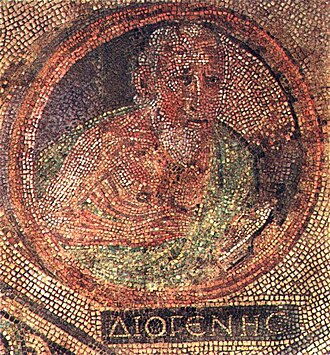
“Diogenes the dog” (kynikós) — refoundaer and principal figure of Cynicism. He lived in a large ceramic jar (pithos) in Athens, reduced his needs to a minimum, and despised all social convention. He said he sought “a human being” (ἄνθρωπον) walking with a lantern lit in broad daylight. When Alexander the Great offered to grant him any desire, he asked only that he step out of his sunlight. He embodied radical anticultural philosophy: virtue requires total self-sufficiency, not abstract philosophy.
Born in Sinope, a Greek city on the shore of the Black Sea, Diogenes was reportedly exiled over an episode involving the defacement of coinage—an anecdote that the tradition turned into the emblem of his philosophy. The oracle supposedly advised him to “deface the currency” (parakharáttein tò nómisma), a phrase he reinterpreted as his mission to devalue society’s established conventions and values, opposing to them physis (nature) as the only legitimate measure. His entire philosophy rests on the contrast between nomos (law, custom, convention) and physis: the sage should live according to nature, free of the artificial needs that culture imposes.
Diogenes’ method was not argument but life lived as demonstration. He practiced askesis—the exercise and discipline of body and desire—in order to attain self-sufficiency (autarkeia) and imperturbability in the face of hardship. His philosophy is less a system of theses than a set of provocative gestures and biting retorts, recorded above all by Diogenes Laërtius: parrhesia (frank, fearless speech) was for him an ethical duty. Refusing homeland, property, and reputation, he declared himself kosmopolites, a citizen of the world—a pioneering formulation that would resonate for centuries. His legacy is immense: through his pupil Crates of Thebes, the teacher of Zeno of Citium, Cynicism transmitted to Stoicism the ideal of life according to nature and indifference to external goods, an influence that extends into the ascetic tradition and moral critique down to the modern age.
Key Concepts
- Autarky: self-sufficiency; total independence
- Anticultural: mathematics, physics, rhetoric are useless for happiness
- Example and action > theory
- Cosmopolitanism: “I am a citizen of the world”
- Critique of enslavement to social conventions
Influenced by
- Antisthenes (founder of Cynicism; disciple of Socrates)
- Socrates — self-sufficiency and indifference to external goods
Influenced
- Zeno of Citium — Zeno was a pupil of Crates; Stoicism inherits much from Cynicism
- Epicurus — simplicity as the path to happiness
- Medieval ascetic thought
Works
None preserved. Sources: Diogenes Laërtius, Lives, VI; Plutarch, Life of Alexander.
See also
Hellenistic Philosophy