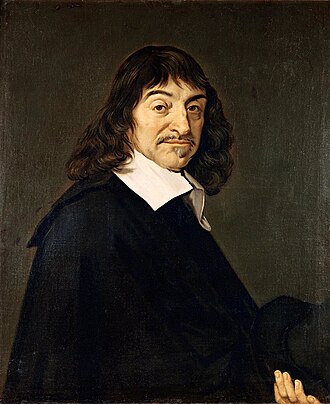
Often called the “father of modern philosophy,” René Descartes was born in 1596 in La Haye, in the French region of Touraine, and was educated at the rigorous Jesuit college of La Flèche. Dissatisfied with bookish learning, he enlisted as a volunteer in the armies of the Thirty Years’ War; it was during this period, by his own account, that in 1619 he glimpsed a universal method capable of giving philosophy the same certainty as mathematics. He spent most of his productive life in the Dutch Republic and died in 1650 in Stockholm, where he had been invited to tutor Queen Christina of Sweden. He was also a great mathematician: analytic geometry and the coordinate system that bears his name are his creations.
His starting point is not being but knowledge: before affirming what exists, one must find an absolutely secure foundation. Hence methodical doubt — to doubt everything that can be called into question, including the senses and even mathematical truths, under the hypothesis of an “evil demon” bent on deceiving him. Yet something remains that doubt cannot shake: the very act of thinking. Even if deceived, the I that thinks necessarily exists — “I think, therefore I am” (cogito, ergo sum), the first certainty and the cornerstone of the whole edifice of knowledge.
From the cogito, Descartes reconstructs reality. From the idea of infinity present in a finite being, he infers the existence of God, whose truthfulness guarantees that reason, rightly conducted, does not deceive us and that the external world exists. Reality is then divided into two irreducible substances: res cogitans (mind, thought) and res extensa (body, extension) — the famous dualism that bequeathed to modernity the thorny “mind-body problem.” His theses founded rationalism and gave impetus to all of modern philosophy: Spinoza, Leibniz, Kant, and Husserl each engage, in their own way, with the Cartesian program.
Key Concepts
- Methodical doubt: to doubt everything systematically in order to find indubitable truth
- Cogito ergo sum: “I think, therefore I am” — the only certainty that doubt cannot eliminate
- Dualism: res cogitans (mind, thought) vs. res extensa (body, extension)
- Innate ideas: God, mathematical axioms, idea of infinity — they do not come from experience
- Method: evidence, analysis, synthesis, enumeration
- God guarantees the reliability of reason and the existence of the external world
- Proof of God: causality of ideas (the idea of infinity cannot come from the finite self)
Influenced by
- Saint Augustine — interiority; si fallor, sum
- Plato — innate ideas
- Mathematics: analytic geometry as a model of certainty
Influenced
- Spinoza — monism as a solution to Cartesian dualism
- Leibniz — pre-established harmony as a solution to the mind-body problem
- Kant — the subject as a condition of knowledge
- Husserl — return to the transcendental ego
- All of modern philosophy
Works
Discourse on Method (1637); Meditations on First Philosophy (1641); Principles of Philosophy (1644); The Passions of the Soul (1649).
See also
Rationalism and Empiricism