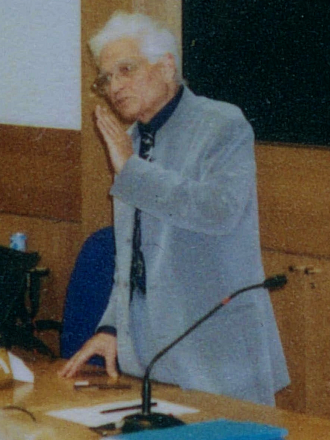
Algerian-French philosopher; founder of deconstruction. He subverted the Western metaphysical tradition by showing that it is structured by hierarchical binary oppositions and by the metaphysics of presence.
Born in El-Biar, on the outskirts of Algiers, into a Jewish family, Derrida trained at the École normale supérieure in Paris and began his philosophical path with a meticulous reading of Husserl’s phenomenology. His explosive entry into intellectual debate came in 1966, with the lecture delivered at Johns Hopkins University, in which he questioned the notion of structure as something organized around a stable center — a gesture that distanced him from the then-dominant structuralism and opened what would come to be called post-structuralism. The following year he published, almost simultaneously, three works that fixed his vocabulary and his method, establishing deconstruction not as a doctrine but as a practice of reading attentive to the tensions that each text fails to master.
Rather than denying truth or dissolving all meaning, deconstruction seeks to show that the conceptual pairs inherited from the tradition — speech/writing, presence/absence, nature/culture — rest on unstable hierarchies that the text itself ends up subverting. Hence the importance of notions such as différance and the supplement, which point to the ceaseless deferral of meaning and to the constitutive character of what was thought to be secondary. Derrida’s work crossed disciplinary boundaries and provoked intense debate — among them the controversy with the philosopher John Searle over speech acts — exerting a lasting influence on literary theory, ethics, and political and legal philosophy, especially in his later reflection on justice, hospitality, and the “to come.”
Key Concepts
- Deconstruction: not destruction, but careful reading that reveals the internal tensions of a text — how the concepts that it excludes or suppresses return to destabilize it
- Metaphysics of presence: Western philosophy privileges presence, speech, origin, identity — Derrida shows that all presence is mediated by difference and absence
- Différance (neologism): play of differ (spatial distinction) and deference (temporal deferment); meaning is never fully present — it is always postponed
- Supplement: the element considered “external” or “secondary” (writing in relation to speech, in Rousseau) proves to be constitutive of the “original”
- Text: “There is nothing outside the text” — does not mean that only books exist, but that all experience is mediated by structures of signification
- Pharmakon (analysis of Plato): writing is at once remedy and poison — an irreducible ambivalence that philosophy attempts, unsuccessfully, to resolve
Influenced by
- Husserl — phenomenology (his 1962 debut: the introduction to The Origin of Geometry)
- Heidegger — destruction of metaphysics (radicalizes the Destruktion)
- Nietzsche — critique of metaphysics and interpretive play
- Ferdinand de Saussure — structural linguistics (critique)
- Sigmund Freud — trace, unconscious, difference
Influenced
- Literary theory (deconstruction in the USA: Paul de Man)
- Postcolonial studies (Spivak, translator of Of Grammatology)
- Queer theory
- Philosophy of law (Force of Law)
Works
Of Grammatology (1967); Writing and Difference (1967); Speech and Phenomena (1967); Margins of Philosophy (1972); Force of Law (1994); Specters of Marx (1993).
See also
Twentieth-Century Philosophy