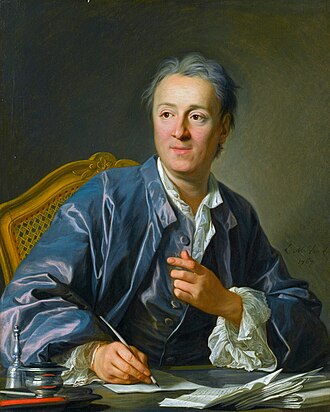
Denis Diderot (1713–1784) is one of the most complex and prolific figures of the French Enlightenment. The son of a cutler from Langres, he studied in Paris, lived through decades of turbulent intellectual life, and was the principal architect of the Encyclopédie ou Dictionnaire raisonné des sciences, des arts et des métiers (1751–1772), which he co-edited with Jean le Rond d’Alembert. The project brought together the greatest minds of the century — Voltaire, Rousseau, Montesquieu, Turgot — with the aim of gathering, systematizing, and disseminating human knowledge in the service of reason and the critique of superstition. Hounded by royal censorship and the Church, the enterprise stands as the greatest monument of the encyclopedist spirit and the Enlightenment faith in the transformative power of knowledge.
Diderot’s philosophical trajectory moves from youthful deism to declared materialism. Shaped by the empiricist epistemology of Locke, Shaftesbury’s moral theory, and Francis Bacon’s inductive method, he progressively abandoned every form of mind-body dualism. The Letter on the Blind for the Use of Those Who See (1749) — in which he explores how a person blind from birth constructs a world without visual images, thereby calling traditional cosmological arguments into question — earned him three months’ imprisonment at the Château de Vincennes. It was there that Rousseau visited him and, by Rousseau’s own account, experienced the illumination that inspired his first Discourse. From that point on, Diderot deepened his conception of matter as living, sentient, and self-organizing: D’Alembert’s Dream (c. 1769) develops, through fictional dialogue, a radically materialist philosophy of nature in which sensibility is a general property of organized matter — anticipating intuitions that only modern biology would come to confirm.
Key Concepts
- Materialism and sentient matter — Diderot argues that matter, in certain forms of organization, acquires sensibility and thought; there is no immaterial soul separate from the body. He develops this thesis most fully in D’Alembert’s Dream and in the Elements of Physiology.
- Encyclopedism — the Encyclopédie is not merely a reference work: it is a political instrument of critique aimed at religious authority and absolutism, whose “Preliminary Discourse” by d’Alembert traces the genealogy of human knowledge back to Bacon, Locke, and Newton.
- Determinism and the critique of free will — in Jacques the Fatalist and His Master (written c. 1765–1784, published posthumously in 1796), Diderot stages universal determinism through the character of Jacques, who attributes everything to what “is written up there,” simultaneously satirizing naive fatalism and the illusion of unconditioned freedom.
- Dialectic of consciousness and the paradox of the actor — Rameau’s Nephew (written c. 1761–1774, published posthumously) presents a tense dialogue between a philosopher and a brilliant parasite, probing the contradiction between virtue and talent, authenticity and performance. Hegel read this text as the paradigmatic expression of self-alienated spirit in Enlightenment culture, devoting key passages of the Phenomenology of Spirit to it.
- Theory of bourgeois drama — in the treatises Conversations on “The Natural Son” (1757) and Discourse on Dramatic Poetry (1758), Diderot proposes a new theatrical genre, the drame bourgeois, which abandons the strict separation between tragedy and comedy to portray middle-class life with emotional naturalism and moral purpose.
- Empirical epistemology and touch as a philosophical sense — the Letter on the Blind shows that knowledge depends radically on sensory experience: alter one sense and the entire cognitive and moral structure of the subject is transformed, anticipating central questions in the philosophy of perception.
Influenced by
- Locke — empiricist epistemology: all knowledge derives from sensory experience
- Francis Bacon — inductive method and the project of systematizing knowledge
- Shaftesbury — moral sense, aesthetics, and critique of religious dogmatism
- Spinoza — immanence and a conception of nature without separate transcendence
- Pierre Bayle — historical skepticism and critique of superstitions
Influenced
- Hegel — read Rameau’s Nephew as a key to understanding alienated consciousness in the Enlightenment
- The Encyclopedists and the European Enlightenment at large
- French and German materialism of the eighteenth and nineteenth centuries (La Mettrie, Holbach; later Feuerbach and Marx)
- Modern aesthetics: the theory of bourgeois drama prefigures the literary and theatrical realism of the nineteenth century
- Biology and philosophy of life: the idea of organized sentient matter anticipates debates in vitalism and evolutionary biology
Works
Philosophical Thoughts (1746); Letter on the Blind for the Use of Those Who See (1749); Letter on the Deaf and Dumb (1751); Encyclopédie (co-editor, 17 text volumes, 1751–1772); The Natural Son (1757); Conversations on “The Natural Son” (1757); Discourse on Dramatic Poetry (1758); Rameau’s Nephew (written c. 1761–1774, published 1805); D’Alembert’s Dream (written c. 1769, published posthumously); Jacques the Fatalist and His Master (written c. 1765–1784, published 1796); The Nun (written c. 1760, published 1796); Elements of Physiology (posthumous).
See also
- Voltaire
- Rousseau
- Locke
- Hegel
- Contractarianism, Enlightenment and Kant