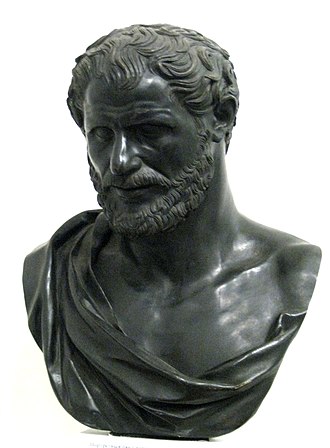
Born in Abdera, in Thrace, and active around 430 BCE, Democritus was one of the most erudite minds of antiquity — he traveled widely and wrote on almost everything, though none of his works has reached us. Tradition nicknamed him “the laughing philosopher,” in contrast to the melancholy Heraclitus. Together with his teacher Leucippus, he is the founder of atomism, the first fully materialist and mechanistic philosophy in history.
His thesis is as simple as it is audacious: reality reduces to two principles — atoms and the void. Atoms (from the Greek atomon, “indivisible”) are eternal, solid, imperceptible particles that differ only in shape, size, position, and arrangement. The void is the space in which they move. Everything that exists — things, the world, and even the soul (made of finer, subtler atoms) — results from the collisions and combinations of these atoms in eternal motion. In Democritus’s cosmos there is neither purpose nor ordering intelligence: everything is explained mechanically, by necessity.
Hence a notable epistemological consequence: sensible qualities (color, taste, heat) exist only “by convention”; “in reality,” there exist only atoms and void. Democritus also developed an ethics: the supreme good is euthymia, serenity or good cheer, attained through moderation of desires. His materialism, marginalized by the Platonic-Aristotelian tradition, would be taken up and adapted by Epicurus (who added the swerve of atoms) and Lucretius, and would resurface with force in modern science. It is no accident that many see in him a distant precursor of contemporary atomic physics — even though his “atoms” were a philosophical intuition rather than an experimental result.
Key Concepts
- Atoms and void as the only constituents of reality
- Mechanism: without purpose, without creator God
- Theory of effluvia (knowledge)
- Euthymia: serene joy as ethical ideal
Influenced by
- Leucippus (teacher)
- Parmenides — adopts indivisible being, but pluralizes it
Influenced
- Epicurus — resumed atomism, adding the clinamen
- Lucretius — De Rerum Natura
- Modern philosophy of matter (Boyle, Gassendi)
Works
None preserved. Sources: Aristotle, De Anima; Diogenes Laërtius, Lives, IX; Simplicius.
See also
Pre-Socratics and Sophists