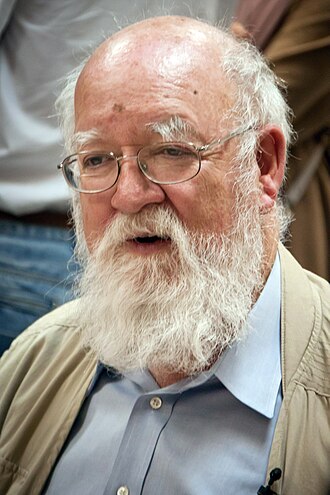
Daniel Clement Dennett was one of the most influential and provocative philosophers of mind and cognitive science of recent decades. A professor at Tufts University, where he co-directed the Center for Cognitive Studies, he defended throughout his career a thoroughgoing naturalism: mind, consciousness, and free will can be fully integrated into a scientific, Darwinian worldview, leaving no mysterious residue behind. A writer of remarkable clarity and wit, Dennett engaged closely with artificial intelligence, evolutionary biology, and neuroscience, and also became a prominent public figure known for his criticism of religion. He died in April 2024.
Key Concepts
The intentional stance (The Intentional Stance, 1987; and in essays from the 1970s): Dennett proposes that, in order to predict the behavior of a complex system, we can adopt different “stances.” The physical stance describes the system in terms of physical laws; the design stance describes it in terms of the function for which it was built; and the intentional stance treats the system as if it had rational beliefs and desires. Attributing intentionality is, first and foremost, a predictive strategy: we say the thermostat “wants” to keep the temperature steady because doing so helps us predict its behavior. The question of whether such states are “real” is reframed as a question about the usefulness and objectivity of the patterns the intentional stance reveals.
The Multiple Drafts Model (Consciousness Explained, 1991): Dennett rejects what he calls the “Cartesian Theater” — the picture of a central place in the brain where “it all comes together” and conscious experience is presented to an inner spectator. In its place he proposes the Multiple Drafts Model: the brain processes information in parallel, producing multiple continuously revised interpretations (“drafts”), with no single moment or place at which something “becomes conscious.” On this view, consciousness has neither a center nor a single script.
Heterophenomenology: Dennett’s proposed method for the third-person scientific study of consciousness. Rather than taking introspective reports as direct, infallible access to mental facts, the researcher treats those reports as data — texts to be interpreted — taking seriously what the subject says without assuming in advance that everything the subject claims about their own experience is true. It is a phenomenology “from the outside.”
Skepticism about qualia (“Quining Qualia,” 1988): Dennett argues against the philosophical notion of qualia as intrinsic, ineffable, private, and directly accessible properties of experience. Through a series of thought experiments, he tries to show that this notion is incoherent and that nothing satisfies all of those criteria at once; what exists are dispositions and reactions that can be explained functionally. The verb “to quine,” coined in his honor, came to mean denying the existence of something seemingly obvious.
Compatibilism about free will (Elbow Room, 1984; Freedom Evolves, 2003): Dennett argues that the kind of free will worth wanting is compatible with determinism. The kinds of freedom and responsibility that really matter — the capacity to deliberate, anticipate consequences, and respond to reasons — require neither indeterminism nor a soul outside the natural order. In Freedom Evolves he argues that freedom is a late product of evolution, something that developed and expanded over the course of natural and cultural history.
Darwinism as “universal acid” (Darwin’s Dangerous Idea, 1995): Dennett presents natural selection as a substrate-neutral algorithm capable of generating design without a designer. The Darwinian idea is described as a “universal acid” that dissolves traditional conceptions of mind, meaning, and purpose, reconstructing them on naturalistic foundations. He also defends multi-level selection and criticizes appeals to “skyhooks” — explanations that invoke design coming “from above” rather than “cranes” built by evolution itself.
Influenced by
- W.V.O. Quine — naturalism and the critique of privileged introspection
- Gilbert Ryle, his advisor at Oxford — the critique of the “ghost in the machine”
- Charles Darwin — population thinking and natural selection
- The nascent fields of artificial intelligence and cognitive science
Influenced
- Contemporary debates in philosophy of mind and cognitive science
- The so-called “New Atheism” (he was one of the “Four Horsemen,” alongside Dawkins, Harris, and Hitchens)
- Discussions of artificial intelligence, memes, and culture
- Empirical research on consciousness and attention
Works
Content and Consciousness (1969); Brainstorms (1978); The Intentional Stance (1987); Consciousness Explained (1991); Darwin’s Dangerous Idea (1995); Freedom Evolves (2003); Breaking the Spell: Religion as a Natural Phenomenon (2006); From Bacteria to Bach and Back (2017); the memoir I’ve Been Thinking (2023). The essay “Quining Qualia” dates from 1988.
See also
David Chalmers John Searle W.V.O. Quine