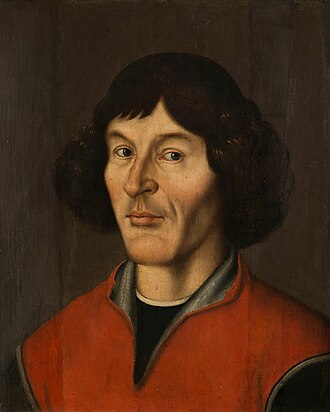
Born in Toruń, Poland, in 1473, Nicolaus Copernicus was a canon of Frombork cathedral and a man of the Renaissance: he studied in Kraków and in Italy (Bologna, Padua), devoting himself to law, medicine, and, above all, astronomy. Discreetly and prudently, over decades he matured an idea that would change the image of the world — and that he would publish only at the end of his life.
That idea is heliocentrism: not the Earth but the Sun is at the center of the planetary system; the Earth is just one more planet, rotating on its own axis and moving around the Sun. It was a break with more than a thousand years of geocentric cosmology, inherited from Ptolemy and Aristotle, according to which the immobile Earth occupied the center of the universe. Copernicus sought not only physical truth but also a mathematically simpler and more harmonious explanation than the complicated Ptolemaic system of epicycles.
His major work, De Revolutionibus Orbium Coelestium, was published in 1543, the year of his death — tradition has it that he received the printed copy on his deathbed. Still bound to some ancient ideas (he kept circular orbits and uniform motion), Copernicus inaugurated the Scientific Revolution: the displacement of humanity from the center of the cosmos had an immense philosophical impact — so much so that Kant would name his own turn a “Copernican revolution.” His ideas would be completed by Kepler, Galileo, and Newton.
Key Concepts
- Heliocentrism: the Sun, not the Earth, is at the center of the planetary system; the Earth rotates on its own axis (rotation) and around the Sun (revolution)
- Critique of Ptolemaic geocentrism: Ptolemy’s system required increasingly complex epicycles to save the phenomena — Copernicus sought a simpler and mathematically more elegant explanation
- Copernican revolution: philosophical metaphor (later used by Kant for his own “revolution”) — the observer is not the fixed center of the world
- Limitations: he maintained circular orbits and uniform motion; Aristotelian geocentric physics had not yet been replaced — this would come with Kepler, Galileo and Newton
Influenced by
- Aristarchus of Samos — ancient heliocentrism (recovered)
- Plato and Pythagoras — mathematical harmony of the cosmos
- Renaissance humanism — return to sources and critique of medieval tradition
Influenced
- Kepler — laws of elliptical planetary motion
- Galileo — defense of heliocentrism with the telescope
- Newton — gravitational synthesis
- Kant — philosophical “Copernican revolution” (metaphor)
- Trial of Bruno and Galileo by the Church
Works
De Revolutionibus Orbium Coelestium (1543); Commentariolus (c. 1514, circulated manuscript).
See also
Scientific Revolution