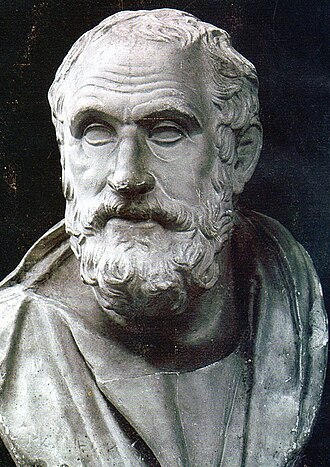
Carneades of Cyrene (c. 214/213–129/128 BC) was the most prominent head (scholarch) of the New Academy in Athens and the central figure of Academic Skepticism. Born in Cyrene in North Africa, he emigrated to Athens and remained there for his entire philosophical career, leading an Academy that had taken a radically skeptical turn since Arcesilaus. Carneades left no writings — an apparently deliberate choice consistent with his position that no thesis should be held dogmatically. His thought reaches us primarily through three mediations: his disciple Clitomachus of Carthage, who recorded his lectures in more than four hundred books; Cicero, who in the Academica and De Natura Deorum presents and debates Academic positions; and Sextus Empiricus, who preserved several of his arguments against the Stoics.
The central philosophical problem Carneades addressed was the critique of the Stoic katalepsis: the doctrine of Zeno of Citium and Chrysippus that a special class of representations is so clear and vivid that it guarantees its own truth (phantasia kataleptike), providing the secure foundation for knowledge. Carneades argued relentlessly that no representation carries such intrinsic guarantee, since false representations may be phenomenally indistinguishable from true ones. His conclusion was not pure Pyrrhonism — the total suspension of judgment even in practical matters — but rather the introduction of the pithanon (the persuasive, the plausible) as a practical criterion for action. A pithane representation is not asserted as true; it simply exerts a persuasive force sufficient to guide conduct without demanding dogmatic certainty. Carneades further distinguished degrees of plausibility: a representation may be merely pithane, or additionally aperispastos (uncontested by other representations), or even periodoumene (systematically examined alongside related representations). This gradation made the pithanon a sophisticated philosophical instrument for everyday life. It is essential not to confuse this concept with modern mathematical probability, which is a quantitative calculation of frequencies — the pithanon is a phenomenological and practical notion, not a statistical one.
The philosophical embassy to Rome in 155 BC — in which Carneades participated alongside the Stoic Diogenes of Babylon and the Peripatetic Critolaus — became a memorable episode in ancient cultural history. Carneades delivered two lectures on successive days: in the first, he defended justice as a natural virtue; in the second, he systematically dismantled every argument he had presented. The effect was alarming to the elder Cato, who persuaded the Senate to expel the philosophers from the city: Academic dialectic, if absorbed by the young, seemed to him corrosive of traditional Roman morality. The episode illustrates the Carneadean method in practice: not adherence to a thesis, but the exploration of reasons on both sides (in utramque partem disputare), a procedure that Cicero himself would adopt as his philosophical ideal.
Key Concepts
- Pithanon (the persuasive/plausible): a practical criterion for action that replaces dogmatic certainty without collapsing into practical paralysis; a pithane representation moves the agent without being asserted as true — fundamentally distinct from modern mathematical probability, which is a quantitative calculation of frequencies
- Critique of katalepsis: the argument that no sense-representation carries an intrinsic guarantee of truth; true and false representations may be phenomenally indistinguishable, making the Stoic criterion of knowledge impossible
- Suspension of assent (epoche): inherited from Arcesilaus and radicalized; the Academic skeptic gives no final assent to any proposition about the nature of things
- Degrees of plausibility: the pithane representation may be merely persuasive, or uncontested, or fully examined — a gradation that supplies a graduated practical epistemology
- In utramque partem: the method of arguing both sides of any question, presenting the reasons for and against without committing to either position
Influenced by
- Arcesilaus — founder of the skeptical turn in the Middle Academy; established epoche as the Academic position
- Plato and the Socratic-Platonic tradition — the Socratic elenctic method as a model of inquiry without definitive theses
- Chrysippus — principal adversary; the logical sophistication of Stoicism demanded an equally rigorous response from Carneades
Influenced
- Clitomachus — disciple and primary transmitter of his thought
- Cicero — the method of disputing in utramque partem; Academic probabilism in Academica, De Natura Deorum, De Divinatione
- Sextus Empiricus — preserved Carneadean arguments against Stoicism
- Hume — through the modern reception of ancient skepticism, the critique of self-certifying impressions resonates in Hume’s empiricist skepticism about causation
Works
Carneades left no writings. The primary sources for his thought are:
- Cicero, Academica (45 BC) — exposition of New Academy positions
- Cicero, De Natura Deorum (45 BC) — arguments against Stoic theology attributed to the Carneadean tradition
- Sextus Empiricus, Adversus Mathematicos and Outlines of Pyrrhonism — preservation of Academic skeptical arguments
- Clitomachus of Carthage (disciple) — more than 400 books, all lost, which mediated the transmission
See also
Pyrrho, Sextus Empiricus, Cicero, Hume, Hellenistic Philosophy