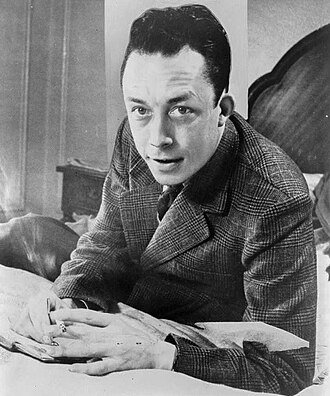
Born in 1913 in French Algeria, into a poor settler (pied-noir) family, Albert Camus lost his father in infancy, in the First World War, and was raised by his illiterate, partly deaf mother in a humble district of Algiers. Tuberculosis would mark his entire life. A journalist and writer, he edited the newspaper Combat in the French Resistance and received the Nobel Prize in Literature in 1957, at the age of 44. Close to existentialism — though he rejected the label — he broke with Sartre over disagreements about revolutionary violence. He died in 1960 in a car accident, at the age of 46.
At the center of his thought lies the absurd: not a property of the world nor of man, but the divorce between the human thirst for meaning and clarity and the indifferent silence of the universe. Facing it, in The Myth of Sisyphus (1942), Camus examines the only philosophical question he considers serious — that of suicide — and rejects both physical suicide and the “philosophical suicide” of the religious leap (which he attributes to Kierkegaard). The authentic response is to hold the tension, to live lucidly without appeal: “one must imagine Sisyphus happy.”
From individual absurdity, Camus moves to revolt in solidarity. In The Rebel (1951), he shows that the act of refusing injustice reveals a value shared by all human beings — “I rebel, therefore we are” — the foundation of an ethics of solidarity opposed to nihilism and to every ideological justification of murder. More than a system, Camus left a literary and philosophical body of work that makes lucidity in the face of the absurd a form of dignity — a lasting influence on human-rights thought and on world literature.
Key Concepts
- The Absurd: born from the confrontation between the human desire for meaning and clarity and the irrational silence of the world
- Three responses to the absurd: physical suicide (cowardice), religious leap of faith (philosophical suicide — Kierkegaard) and revolt (Camus’s position)
- Revolt: continuing to live and create despite the absurd; affirmation of life without illusions
- “One must imagine Sisyphus happy” — revolt is lucid happiness
- Human solidarity as the foundation of ethics (against nihilism)
Influenced by
- Nietzsche — death of God, creation of values
- Kierkegaard — absurd (but Camus refuses the leap of faith)
- Dostoevsky — revolt and suffering
Influenced
- Political thought of resistance and human rights
- Existentialist literature worldwide
Works
The Myth of Sisyphus (1942); The Stranger (novel, 1942); The Plague (novel, 1947); The Rebel (1951); Summer (1954).
See also
Twentieth Century Philosophy