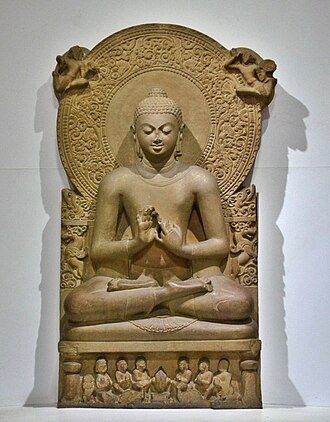
Note on sources and dating: The dates of Siddhārtha Gautama (also called Śākyamuni, “the sage of the Śākya clan”) are a matter of scholarly controversy. The traditional chronology places him at c. 563–483 BCE, but revised research of recent decades favours a “short chronology,” locating his death around 400 BCE (an approximate lifespan of c. 480–400 BCE). Equally important: the Buddha’s teachings were transmitted orally for generations and were only set down in writing centuries later, above all in the Pāli Canon (Tipiṭaka, Sanskrit Tripiṭaka). These texts are therefore not writings of the Buddha himself but later records of the monastic community, and reconstructing what he historically taught is a delicate philological task.
The Buddha did not present himself as a god or as the revealer of supernatural truths, but as one who had “awakened” (buddha means “awakened one”) to the nature of suffering and the path beyond it. His philosophy is eminently practical and therapeutic: it begins from a diagnosis of the human condition and proposes a regimen of transformation. He rejected both extreme asceticism and the pursuit of pleasure, formulating a middle way.
Key Concepts
The Four Noble Truths (catvāri āryasatyāni): the core of the teaching. (1) The truth of suffering (dukkha) — conditioned existence is marked by dissatisfaction, pain, and transience; (2) the truth of origin (samudaya) — suffering arises from craving or thirst (taṇhā); (3) the truth of cessation (nirodha) — suffering can be extinguished by extinguishing its craving; (4) the truth of the path (magga) — there is a method for this cessation, the Noble Eightfold Path.
The Noble Eightfold Path (āryāṣṭāṅgamārga): the practical-ethical programme of eight factors leading to the cessation of suffering — right view, right intention, right speech, right action, right livelihood, right effort, right mindfulness, and right concentration. Traditionally grouped into wisdom, ethical conduct, and meditative discipline.
No-self (anātman, Pāli anattā): a central and distinctive doctrine. There is no substantial, permanent, unchanging “self” behind experience. What we call the “self” is a provisional compound of factors (the five skandhas: form, sensation, perception, mental formations, and consciousness). This is a direct break with the notion of ātman found in the Upaniṣads.
Impermanence (anicca): everything conditioned is in continuous flux; nothing that arises remains identical to itself. The illusion of permanence is one of the roots of attachment and therefore of suffering.
Dependent origination (pratītyasamutpāda): the principle that phenomena arise in mutual conditioned dependence — “this being, that arises.” Nothing exists in isolation or self-sufficiently; suffering in particular is described as a conditioned chain of factors that can be interrupted.
Nirvāṇa: the extinction (literally “blowing out,” as of a flame) of craving, aversion, and delusion, and with it of the cycle of rebirths (saṃsāra). It is described neither as annihilation nor as ordinary positive existence, but as the unconditioned cessation of suffering.
The Middle Way (madhyamā pratipad): the rejection of two extremes — ascetic mortification and surrender to sensory pleasure — both held to be ineffective for liberation.
Influenced by
- Vedic and Upaniṣadic tradition — the context to which he reacted critically, especially the notion of ātman and Brahmanical ritualism
- The śramaṇa movements — the ascetic and renunciant currents of his time, which he both joined and departed from
- Jainism and the figure of Mahāvīra — a contemporary tradition with which Buddhism engaged and diverged
Influenced
- The entire Buddhist tradition — the Theravāda, Mahāyāna, and Vajrayāna schools
- Nāgārjuna (2nd–3rd century CE) — Madhyamaka philosophy radicalizes dependent origination and emptiness (śūnyatā)
- Comparative philosophy of mind — contemporary dialogues on the “self” with Hume, phenomenology, and the cognitive sciences
- Schopenhauer — a Western reading that drew his metaphysics (with some liberties) close to Buddhist soteriology
Works
The Buddha left no writings. The teachings attributed to him were preserved orally and later codified, in their oldest surviving form, in the Pāli Canon (Tipiṭaka), divided into three “baskets”: the Vinaya Piṭaka (monastic rules), the Sutta Piṭaka (discourses), and the Abhidhamma Piṭaka (later doctrinal systematization). Famous discourses such as the “Sermon at Benares” (Dhammacakkappavattana Sutta), which sets out the Four Noble Truths, belong to this corpus. Caution is required: attributing any specific passage to the historical Buddha is a matter of philological debate, and later strata (such as the Abhidhamma) reflect developments within the community rather than the founder’s direct words.
See also
Eastern Philosophy; Confucius; Laozi