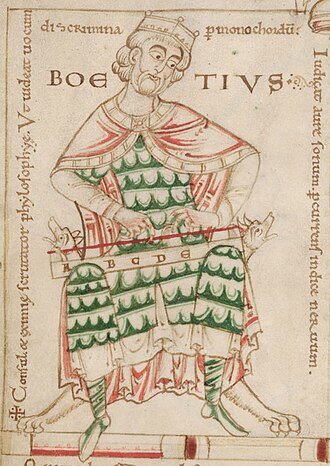
“The last Roman and the first Scholastic.” He translated and commented on the Logic of Aristotle into Latin, transmitting it to the Middle Ages. The Isagoge of Porphyry — which Boethius translated and commented on — (introduction to the Categories) launched the debate of universals that will dominate Scholasticism. Imprisoned and condemned to death by Theodoric, he wrote The Consolation of Philosophy in prison — one of the most widely read works of the Middle Ages.
A member of an old and illustrious Roman senatorial family, Anicius Manlius Severinus Boethius lived in an Italy that, though ruled by Theodoric’s Ostrogoths, still preserved the institutions and culture of the late Roman world. Consul and later magister officiorum — one of the highest posts in the administration — he combined public office with an intellectual project of enormous ambition: to translate into Latin the whole work of Plato and Aristotle and to show the fundamental harmony between the two philosophers. The plan remained unfinished, but what he did accomplish proved decisive. In a West where knowledge of Greek was rapidly dying out, his versions and commentaries on Aristotelian logic and on the Isagoge became, for centuries, virtually the only doorway into that tradition. Boethius also bequeathed to medieval education the vocabulary of the arts: it was he who coined the term quadrivium for the cluster of mathematical sciences (arithmetic, music, geometry, and astronomy), writing treatises such as the De arithmetica and the De musica.
The Consolation of Philosophy, composed in prison while he awaited execution, is a prosimetrum — an alternation of prose and verse — in which the figure of Philosophy, appearing as a lady of majestic bearing, leads the prisoner from despair to serenity. She unmasks the goods of Fortune as unstable and illusory, identifies true happiness with the supreme Good, which is God himself, and confronts the classic problem of reconciling divine foreknowledge with free will: God does not know the future “beforehand,” in time, but contemplates it in an eternal present, defined as the complete, simultaneous, and perfect possession of unlimited life. Remarkably, although a Christian and the author of theological treatises (the Opuscula sacra), Boethius builds this consolation using only the resources of philosophical reason, without recourse to Scripture. Through this synthesis of ancient heritage and Christian horizon, he became one of the great masters of the Middle Ages, read and commented on from Thomas Aquinas to Dante.
Key Concepts
- Transmission of Aristotelian logic to medieval Latin
- Dispute of universals: moderate realism
- True happiness = approximation to God; external goods are false goods
- Divine providence and free will: God’s eternity vs. human time
- Fortune as a wheel: everything that rises falls
Influenced by
- Aristotle — logic, philosophy
- Plato — the Good as end
- Plotinus — providence
Influenced
- Anselm of Canterbury — dispute of universals
- Thomas Aquinas — via moderate realism
- All of Scholasticism — intermediary of Aristotle
Works
The Consolation of Philosophy; translations and commentaries of Categories, On Interpretation, Isagoge by Porphyry.
See also
Medieval Philosophy