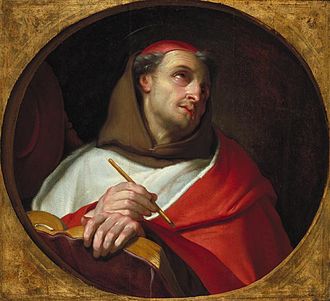
Giovanni di Fidanza, known as Bonaventure of Bagnoregio. Franciscan theologian and philosopher; cardinal and Minister-General of the Franciscan Order. Contemporary and cordial adversary of Thomas Aquinas. Called the Doctor Seraphicus.
Bonaventure trained at the University of Paris, then the great center of Latin scholasticism, where he studied the liberal arts and afterward theology under the Franciscan master Alexander of Hales. There he taught at the same time as Thomas Aquinas, in a period when the massive arrival of the works of Aristotle — many of them mediated by the Arabic commentaries of Averroes — was forcing Christian theologians to decide how much of the new natural philosophy they could absorb without compromising the faith. Bonaventure embodies the Augustinian and Franciscan response to that challenge: rather than fully naturalizing reason as Aquinas did, he upheld the primacy of divine illumination and inner experience, refusing to treat philosophy as an autonomous knowledge severed from the wisdom that leads to God.
His career joined thought and governance. In 1257 he was elected Minister-General of the Franciscan Order, at a moment of tension between the order’s stricter and more lenient wings over poverty, and he wrote the official biography of Francis of Assisi (the Legenda Maior), becoming a decisive figure in the institutional and spiritual consolidation of the order. He was also involved in the dispute between the secular clergy and the mendicant orders at the university. Created a cardinal, he took part in the Second Council of Lyon, devoted to union with the Greek Church, during which he died, in 1274. His synthesis of mysticism, Neoplatonic exemplarism, and affective theology exerted a lasting influence on the Franciscan school and on the whole contemplative tradition of Western Christianity.
Key Concepts
- Itinerary of the Mind to God (Itinerarium Mentis in Deum, 1259): the soul ascends to God in six steps — from the external world (vestiges of God in creation) to the interior (soul as image of God) to the superior (contemplation of God in itself); divine illumination is necessary at each stage
- Divine illumination: human knowledge requires a special light infused by God — inheritance from Augustine against the pure Aristotelianism of Thomas Aquinas
- Exemplarism: creatures are vestiges (vestigia), images (imagines) or similitudes (similitudines) of God — the world is a book that speaks of God
- Theology as affective wisdom: theology is not theoretical science but sapientia — knowledge that moves toward love; contemplation surpasses speculation
- Creation in time: against Aristotle and Averroes, the world is not eternal — it was created from nothing (ex nihilo)
Influenced by
- Augustine — illuminism, interiority and love
- Plato (via Augustine) — exemplarism and participation
- Anselm of Canterbury — ontological argument and faith seeking understanding
- Francis of Assisi — Franciscan spirituality
Influenced
- Later Franciscan school (Duns Scotus, Ockham — though divergent)
- Western Christian mysticism
- Thomas Aquinas — debate on the eternity of the world
Works
Commentary on the Sentences of Peter Lombard (1248–1255); Itinerary of the Mind to God (1259); Reduction of the Arts to Theology (1255); The Triple Way (c. 1259).
See also
Medieval Philosophy