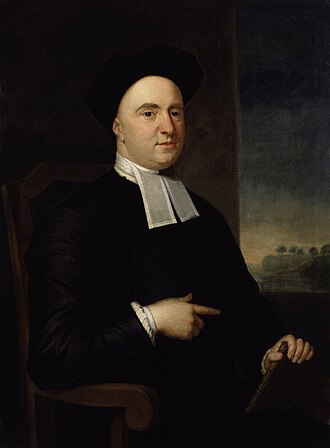
An Irish philosopher born in 1685 and later the Anglican Bishop of Cloyne, George Berkeley produced his most important philosophical works while still very young, before the age of thirty. A man of faith and action, he even crossed the Atlantic with a project to found a college in Bermuda for the American colonies. He is remembered as the second great name of British empiricism, between Locke and Hume — and the most surprising of the three, for pushing empiricism to a radical conclusion: that matter does not exist.
Berkeley’s reasoning sets out from Locke but goes beyond him. If all we know are our ideas and perceptions, he asks, what sense is there in supposing, “behind” them, a material substance that we never perceive? Such matter would be a useless and contradictory hypothesis. His famous formula sums up the thesis: esse est percipi — “to be is to be perceived.” Objects are not material things but stable collections of ideas; to exist, for a sensible thing, is to be perceived by a mind.
But does the world then cease to exist when no one observes it? No — and here God enters. Objects persist because they are continuously perceived by the infinite mind of God, who is also the cause of the order and regularity of our perceptions; nature is, so to speak, the “language” by which God addresses created spirits. Far from being skepticism, Berkeley’s immaterialism sought to defend common sense and religion against materialism. Its difficulties propelled the skepticism of Hume and the transcendental idealism of Kant.
Key Concepts
- Esse est percipi (“to be is to be perceived”): material objects are merely collections of ideas in the mind; there is no material substance behind perceptions
- Critique of Locke’s primary qualities: Locke distinguished primary qualities (in the object: extension, shape) from secondary ones (in the mind: color, taste). Berkeley argues that primary qualities too are merely ideas — the distinction collapses
- Immaterialism: denying matter is not skepticism, it is eliminating an unnecessary hypothesis; ideas are real and things exist insofar as they are perceived
- God as guarantor: objects continue to exist when we do not perceive them because God perceives them continuously — the world is God’s language with minds
- Critique of the abstract: abstract general ideas (such as “triangle in general”) are impossible for the human mind; only particular ideas exist
Influenced by
- Locke — empiricism and theory of ideas (Berkeley radicalizes it)
- Descartes — mind/matter dualism (Berkeley suppresses matter)
- Malebranche — occasionalism and the role of God
Influenced
- Hume — skepticism (Berkeley showed the aporias of empiricism)
- Kant — transcendental idealism (critique and overcoming)
- German Idealism (esse est percipi resonates in Fichte)
- Contemporary philosophy of perception
Works
An Essay Towards a New Theory of Vision (1709); A Treatise Concerning the Principles of Human Knowledge (1710); Three Dialogues between Hylas and Philonous (1713).
See also
Rationalism and Empiricism
Recommended Books:
 The Works of George Berkeley. Vol.1 of 4: Philosophical Works, 1705-21
Ver na Amazon →
The Works of George Berkeley. Vol.1 of 4: Philosophical Works, 1705-21
Ver na Amazon →
 Three Dialogues Between Hylas and Philonous (English Edition)
Ver na Amazon →
Three Dialogues Between Hylas and Philonous (English Edition)
Ver na Amazon →