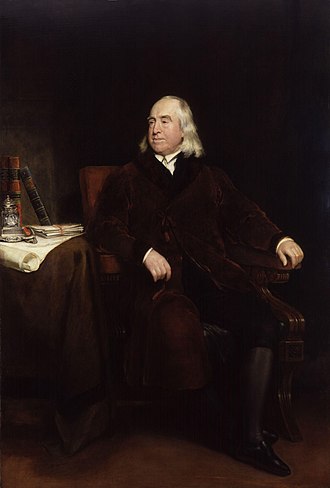
Founder of Utilitarianism. English jurist and philosopher; radical social reformer. His skeleton (Auto-Icon) is displayed at University College London, in accordance with his will.
Trained for the bar, Bentham soon abandoned the practice of law to devote himself to its critique. His first target was the English common law and, in particular, William Blackstone’s Commentaries on the Laws of England, which he accused of cloaking privilege and arbitrariness in solemn language. Against that tradition Bentham proposed a single, clear, measurable standard for evaluating laws and institutions: the principle of utility, according to which the worth of any action, law, or policy is measured by the amount of happiness — understood as pleasure and the absence of pain — that it produces for those affected. Morals and legislation would thus cease to rest on tradition, intuition, or supposed natural rights (which he dismissed as “nonsense upon stilts”) and become the object of a rational, secular calculation grounded in the empirical observation of human motives.
This programme made Bentham less an armchair philosopher than an engineer of reforms. He spent decades on concrete projects of legal codification, penal reform, education, poor relief, and administrative organisation, convinced that well-designed institutions could align individual interest with collective welfare. Around him formed the circle of the Philosophical Radicals, which included James Mill and, in the next generation, John Stuart Mill, and which carried utilitarianism into nineteenth-century British political and economic debate. Bentham’s legacy is twofold and ambivalent: on one hand, the idea that public policies must be justified by their consequences for general welfare, a basis of welfare economics and modern policy analysis; on the other, the Panopticon, an architectural design for surveillance that Foucault would turn into a symbol of disciplinary societies.
Key Concepts
- Principle of Utility: every action should be judged by its result — the greatest happiness for the greatest number
- Psychological hedonism: nature has placed mankind under two sovereign masters — pleasure and pain
- Felicific Calculus (felicific calculus): measuring pleasures and pains by intensity, duration, certainty, propinquity, fecundity, purity, extent
- Panopticon: circular prison where a guard can observe all without being seen — model of social control through surveillance
- Reform of legislation: laws must be calculated to maximize public utility
Influenced by
- Hume — sentiments of pleasure/pain as criterion
- Helvétius — social happiness as the end of legislation
- Locke — empiricism
Influenced
- John Stuart Mill — disciple who qualified utilitarianism
- Foucault — analysis of the Panopticon in Discipline and Punish
- Contemporary law and politics
Works
Introduction to the Principles of Morals and Legislation (1789); writings on the Panopticon.
See also
Nineteenth-Century Philosophy