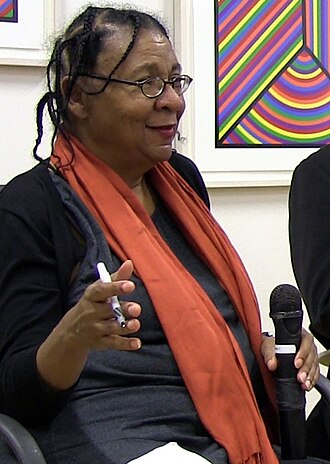
bell hooks — pen name of Gloria Jean Watkins (Hopkinsville, Kentucky, 25 September 1952 — Berea, Kentucky, 15 December 2021) — was an American writer, feminist theorist, and cultural critic. She took the name of her great-grandmother, Bell Blair Hooks, and deliberately wrote it in lowercase, to shift attention from the author to the ideas. A prolific author, she wrote on feminism, race, education, mass culture, and love, always in an accessible prose addressed to a broad public.
The central problem of her work is the blindness of mainstream feminism to race and class. In Ain’t I a Woman? (1981) — a title taken from the speech attributed to Sojourner Truth — hooks argues that second-wave feminism, in speaking on behalf of “woman,” in fact projected the experience of the white middle-class woman, leaving out Black and poor women.
Hence her insistence on thinking oppressions in an articulated way — which she condensed in the formula “white-supremacist capitalist patriarchy” — and on conceiving feminism not as an identity club, but as a political project of transformation. Influenced by Paulo Freire, she devoted much of her work to education as a practice of freedom.
Key Concepts
- Feminism as a movement: she defines feminism as “the movement to end sexism, sexist exploitation, and oppression” — a political struggle, not the assertion of an identity or the inversion of a hierarchy.
- The race–class–gender intersection: she criticizes white feminism for ignoring that gender, race, and class operate together; she anticipates and converses with intersectionality.
- “White-supremacist capitalist patriarchy”: a phrase naming the interlocking of systems of domination, refusing monocausal explanations.
- Engaged pedagogy (Teaching to Transgress, 1994): inspired by Paulo Freire, an education that links theory and experience and treats learning as a practice of freedom.
- The “oppositional gaze”: the Black spectator’s critical refusal of dominant representations in mass culture.
Influenced by
- Sojourner Truth and the Black feminist tradition
- Paulo Freire — the pedagogy of the oppressed
- Malcolm X and Martin Luther King — thought on race and liberation
- Buddhism — the spiritual dimension of love and community
Influenced
- Black feminism and intersectional studies
- Critical pedagogy and cultural studies
- The public debate on love, race, and mass culture
Works
Ain’t I a Woman? (1981); Feminist Theory: From Margin to Center (1984); Teaching to Transgress (1994); All About Love (2000).
See also
Simone de Beauvoir, Paulo Freire, Gayatri Spivak