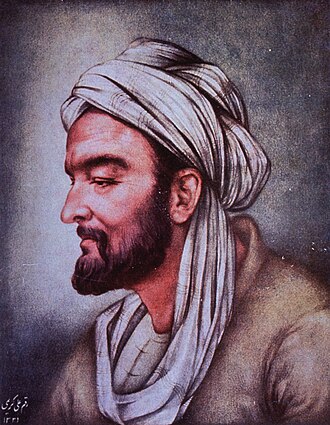
Born in 980 near Bukhara, in Persian-speaking Central Asia, Abu Ali Ibn Sīnā — Latinized as Avicenna — was a prodigy: it is said that by the age of eighteen he had already mastered the medicine of his time. He led a turbulent life, amid courts, imprisonments, and posts as vizier, yet left more than two hundred works. His Canon of Medicine was the principal medical textbook in the West for centuries, and his Book of Healing is a vast philosophical encyclopedia. He is the greatest philosopher of the medieval Islamic world, and his name is bound to a distinction that would transform Western metaphysics.
That distinction is the one separating essence and existence. In any being, we can ask what it is (its essence) and whether it is (its existence) — and the two do not coincide: the essence of a horse says nothing about whether horses exist. From this Avicenna draws a decisive conclusion: in creatures, existence is contingent (they might not exist), whereas only in God do essence and existence coincide — God is the “Necessary Being,” that which cannot not be and on which everything else depends.
Combining Aristotle with the neoplatonism of Plotinus, Avicenna explains the origin of the world through a series of ten intelligences that emanate from God, the last of which illuminates the human intellect. Famous too is his argument of the “flying man”: imagining a man created in the air, devoid of any sensation, he would still be aware of existing — a sign that the soul knows itself independently of the body, anticipating intuitions of Descartes. His metaphysics was decisive for Thomas Aquinas, Duns Scotus, and the whole of Scholasticism.
Key Concepts
- Being and essence: being exists in fact; essence says what each thing is. Only in God does essence = existence (necessary being); in creatures existence is contingent/possible
- Ten intelligences: God emanates the first intelligence (mover of the 1st heaven); in cascade down to the 10th, which radiates forms upon the sublunary world and actualizes the human intellect
- Argument of the “Flying Man”: argument for self-awareness independent of the body (anticipates Descartes’ cogito)
Influenced by
- Aristotle — logic, metaphysics
- Plotinus and neoplatonism (via Al-Farabi)
Influenced
- Thomas Aquinas — distinction of being/essence, contingent existence
- Duns Scotus — univocity of being
- Medieval European medicine (Canon of Medicine)
Works
Book of the Cure (Shifa) — philosophical encyclopedia; Canon of Medicine; Book of Salvation.
See also
Medieval Philosophy