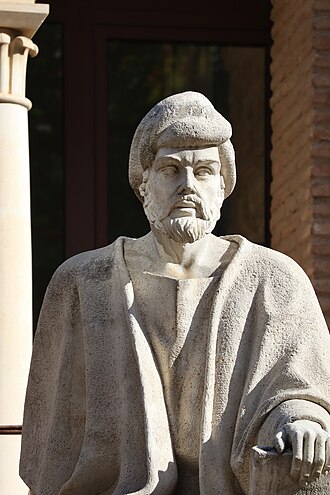
Abu al-Walid Muhammad Ibn Rushd, Latinized as Averroes, was born in Córdoba in 1126, at the height of the Islamic civilization of Al-Andalus. A judge (qadi), physician, and philosopher in the service of the Almohad caliphs, he became known in medieval Europe simply as “the Commentator”: his meticulous commentaries on the work of Aristotle were, for centuries, the principal gateway to Aristotelian thought for Latins and Jews. He fell from favor at the end of his life, when his works were condemned, and died in Marrakesh in 1198.
For Averroes, the philosophy of Aristotle represented the summit of rational truth, and his great theme was the relation between philosophy and religion. In response to the theologian al-Ghazali, who had accused the philosophers of incoherence, he wrote The Incoherence of the Incoherence, arguing that philosophy and revelation, far from contradicting each other, are two paths — one demonstrative, the other persuasive — to the same truth. Hence his thesis of the autonomy of philosophy, with a domain of its own alongside theology.
His most controversial positions were the defense of the eternity of the world (against creation in time) and, above all, the doctrine of the unique intellect: there would be a single intellect, common to all humanity, in which individuals participate — a thesis that seemed to deny the personal immortality of the soul. Transplanted to the University of Paris by the “Latin Averroists” (such as Siger of Brabant), it provoked an intense reaction from Thomas Aquinas and became one of the great debates of Scholasticism. Averroes was thus both a decisive transmitter of and a provocateur within medieval Christian thought.
Key Concepts
- Unique intellect: there is a single possible intellect for all humanity (not individual); men “participate” in it via fantasy/imagination. The individual intellect is not immortal
- Eternity of the world: the world is eternal (God’s final cause, not efficient cause); creation in time is incoherent
- Autonomy of philosophy: philosophy has its own domain; theology has its own → this precedes the doctrine of double truth
- Latin Averroism: Siger of Brabant transported these theses to Paris, generating conflict with Thomas Aquinas
Influenced by
- Aristotle — systematic commentator
- Avicenna (criticizes and surpasses in some points)
Influenced
- Thomas Aquinas — denies the unique intellect; recognizes Averroes as a central interlocutor
- Latin Averroism (Siger of Brabant, 13th cent.)
- Renaissance Philosophy (Pomponazzi)
Works
Commentaries on nearly all works of Aristotle (long, middle, and short form); The Incoherence of the Incoherence (response to Al-Ghazali).
See also
Medieval Philosophy