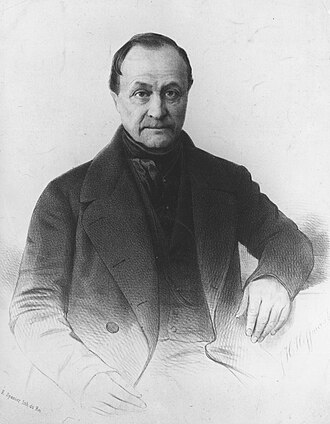
French philosopher; founder of positivism and father of sociology as a scientific discipline. Disciple of Saint-Simon, from whom he later broke; proposed to reorganize society on scientific bases following the dual revolution (French and industrial).
Comte wrote under the impact of the crisis opened by the French Revolution: the traditional order, sustained by theology and monarchy, had collapsed, yet no new principle of social cohesion had stably replaced it. His central problem is therefore at once intellectual and political — how to rebuild social consensus in an age in which religious authority has lost its force. Comte’s answer is the positive spirit: replacing the search for ultimate causes and hidden essences with the study of the laws that govern observable phenomena. Knowledge ceases to ask “why” in a metaphysical sense and instead describes “how” facts relate to one another in a constant manner, making possible prediction and rational action upon nature and society.
Comte’s ambition is encyclopedic: to classify and coordinate all the sciences in a single hierarchy and to crown it with a science of society itself. One may distinguish here a “scientific” Comte, from the phase of the Course in Positive Philosophy, and a later Comte, more moralistic and religious, from the phase of the System of Positive Politics, in which positivism turns into a project for the spiritual regeneration of humanity. His work exerted a lasting influence on sociology, epistemology, and political culture — particularly in republican Brazil, where positivist ideals deeply shaped institutional thought at the end of the nineteenth century.
Key Concepts
- Law of Three Stages: each science and each society passes through three historical stages:
- Theological: explanation by supernatural agents (fetishism → polytheism → monotheism)
- Metaphysical: explanation by forces and abstract essences
- Positive (scientific): explanation by observable and measurable laws — the only valid stage
- Positivism: only knowledge based on observable facts and verifiable relations is legitimate; rejection of metaphysics and theology as immature
- Hierarchy of Sciences: mathematics → astronomy → physics → chemistry → biology → sociology (the most complex and most recent)
- Sociology: positive science of society — Social Physics; divided into statics (order, structure) and dynamics (progress, change)
- Religion of Humanity: late phase — Comte proposed replacing God with Humanity as the object of worship, with rituals and positivist calendar (Positive Politics)
Influenced by
- Saint-Simon — social reorganization through science and industrialism
- Condorcet — historical progress and human perfectibility
- Montesquieu — laws in social history
- French Enlightenment — reason and science
Influenced
- Émile Durkheim — scientific sociology
- John Stuart Mill — methodology and positivism (with reservations)
- Twentieth-century logical positivism (distant reading)
- Brazil — the motto “Order and Progress” on the flag is directly Comtean
Works
Course in Positive Philosophy (6 vols., 1830–1842); Discourse on the Positive Spirit (1844); System of Positive Politics (4 vols., 1851–1854).
See also
Nineteenth-Century Philosophy