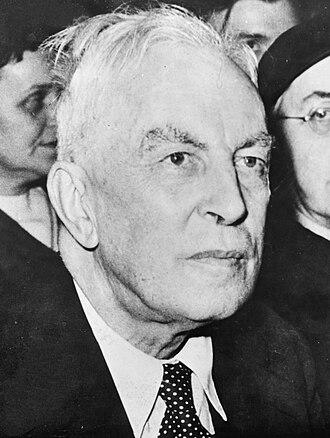
Arnold Joseph Toynbee (1889–1975) was born in London and trained in classical Greco-Roman history at Balliol College, Oxford. He served in the British Foreign Office during and after the First World War and directed, for decades, the research department of the Royal Institute of International Affairs (Chatham House), combining academic erudition with intense engagement in the analysis of international affairs. His magnum opus, A Study of History, published in twelve volumes between 1934 and 1961, is the twentieth century’s most ambitious attempt to write a comparative history of all known civilizations, identifying roughly twenty-one of them across human history and proposing a common scheme for understanding their genesis, growth, breakdown, and disintegration.
Unlike Spengler, whose Decline of the West he knew and discussed, Toynbee rejected the biological determinism of Spengler’s morphology: for him, the fate of civilizations is not fatally written from birth but depends on human responses — always free and fallible — to concrete environmental or social challenges. This scheme, dubbed “challenge-and-response,” became his most debated contribution: a civilization arises when a human group, the “creative minority,” finds a successful response to a challenge of intermediate difficulty (neither too trivial, which would make a response unnecessary, nor too harsh, which would crush it); it grows as long as that minority keeps formulating creative responses, followed by the majority through imitation; it enters breakdown when the creative minority degenerates into a mere “dominant minority,” which enforces obedience by force rather than attracting by example; and it disintegrates through a “universal state,” a “universal church,” and the migrations of external peoples that prepare the successor civilization. The work achieved enormous public resonance in the United States and Britain of the 1950s, but it drew sharp methodological criticism from the Dutch historian Pieter Geyl and the British historian Hugh Trevor-Roper, who accused Toynbee of imposing an a priori, selectively confirmed scheme on the historical evidence and of drifting, in his final volumes, toward religious prophecy rather than history proper.
Key Concepts
- Challenge-and-response: the central mechanism by which a civilization is born and develops — a people’s creative and successful response to a challenge of intermediate difficulty drives its growth; trivial or overwhelming challenges do not generate civilization.
- Creative minority: the group within a rising civilization whose innovative responses to challenges are imitated, through “mimesis,” by the majority; when this minority loses its creative capacity and rules by force alone, it becomes a “dominant minority” — a symptom of civilizational breakdown.
- Genesis, growth, breakdown, and disintegration: the four phases of Toynbee’s civilizational cycle, distinct from Spengler’s rigid biological scheme in that they depend on human decisions rather than an inescapable organic fate.
- Universal state and universal church: in the final stages of disintegration, a civilization tends to unify under a coercive empire (a universal state, such as the Roman Empire) which, paradoxically, fosters the formation of a universal church capable of surviving political collapse and serving as a “chrysalis” for the successor civilization.
- Rejection of determinism: unlike Spengler, Toynbee holds that there is no biological necessity in the decline of civilizations — breakdown results from “suicide,” not “murder” or fate, that is, from human failures of creative response that could, in principle, have been avoided.
Influenced by
- Oswald Spengler — Toynbee absorbs the comparative project of a morphology of civilizations, but expressly rejects the biological determinism of The Decline of the West
- Classical Greek historiography, above all Thucydides, whose analysis of the Peloponnesian War served as a comparative model
- Bergson — the emphasis on creativity as a historical force, against purely mechanical explanations
- Christian religious thought, especially in his later phase, which led him to read history as a process endowed with spiritual, not merely secular, dimension
Influenced
- Debates on comparative historiography and macro-history in the twentieth century, even among his sharpest critics, such as Pieter Geyl and Hugh Trevor-Roper
- Francis Fukuyama and other contemporary theories of historical teleology, by contrast and reaction
- Studies of civilization in international relations and comparative political science
- Broad popular reception in the United States and Britain of the 1950s–60s, via D. C. Somervell’s condensed version
Works
A Study of History, 12 vols. (1934–1961); Civilization on Trial (1948); The World and the West (1953); Reconsiderations (vol. 12, 1961); Mankind and Mother Earth (1976, posthumous).
See also
Oswald Spengler, Hegel, Francis Fukuyama, Bergson