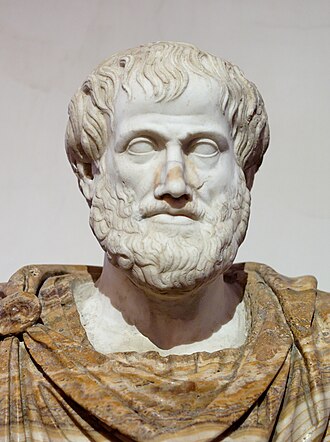
Born in Stagira, in Macedonia, around 384 BCE, the son of Nicomachus — physician to the Macedonian court — Aristotle entered Plato’s Academy at the age of seventeen, where he remained for some twenty years, until his master’s death. He later tutored Alexander the Great and, in 335 BCE, founded the Lyceum in Athens, a school whose members became known as Peripatetics (from their habit of discussing while walking). With Alexander’s death and the wave of anti-Macedonian feeling, he left Athens in 323 BCE — so that the city, according to ancient tradition, “might not sin twice against philosophy” — and died the following year in Chalcis. The body of texts we have inherited from him is the largest and most systematic of antiquity, spanning logic, physics, biology, psychology, metaphysics, ethics, politics, rhetoric, and poetics.
His originality lies in bringing the Forms back into the world. Against Plato’s dualism, which placed essences on a separate plane, Aristotle is an immanentist: form lies within the thing itself, united with matter (hylomorphism). To explain change, he distinguishes act and potency — motion being the passage from what something can be to what it actually becomes — and identifies four causes (material, formal, efficient, and final) that answer the “why” of each being. At the summit of this physics stands the Unmoved Mover, the final cause that moves the eternal cosmos without itself being moved. He was also the founder of formal logic: the Organon and the theory of the syllogism gave deduction its first rigorous structure.
In ethics, the ultimate end of human life is eudaimonia (flourishing, a fulfilled life), attained through the exercise of virtue, understood as the mean (mesotes) between two excesses and guided by practical wisdom (phronesis). As a “political animal” (zoon politikon), the human being fully realizes itself only in the polis. Aristotle’s influence was so vast that, in the Middle Ages, one had only to say “the Philosopher” to be understood: commented upon by Avicenna and Averroes and incorporated into Christianity by Thomas Aquinas, he shaped the vocabulary of Western philosophy to this day.
Key Concepts
- 4 causes: material, formal, efficient, final
- Act and potency: movement is the passage from potency to act
- Unmoved Mover: God = thought of thought, final cause of the eternal universe
- Ousia (substance): form + matter (hylomorphism)
- Eudaimonia: human flourishing as ultimate end; virtue as the mean
- Syllogism: basic structure of deductive reasoning
- Catharsis: purification of emotions through tragedy
- Man = political animal
Influenced by
- Plato (master — dialogues with and critiques)
- Democritus — empiricism and naturalism
- Heraclitus — becoming; act/potency
Influenced
- Avicenna — principal interpreter of Aristotle (“the Philosopher”) in the Arab world
- Averroes — “the Commentator”
- Thomas Aquinas — synthesis with Christianity
- Albert the Great — introduction to medieval West
- Modern science (Galileo rejects Aristotle, but builds from him)
- Hegel — logic and dialectic
Major Works
Organon (logic), Physics, Metaphysics, On the Soul, Nicomachean Ethics, Politics, Poetics, Rhetoric.
See also
Socrates, Plato and Aristotle