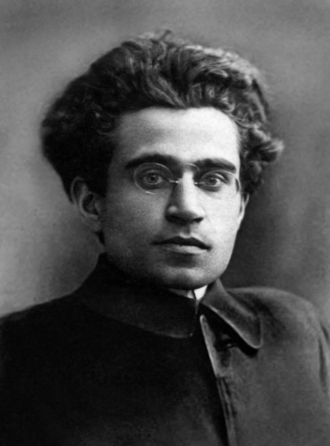
Antonio Gramsci (22 January 1891, Ales, Sardinia — 27 April 1937, Rome) was an Italian philosopher, journalist, and Communist leader, one of the most original figures of twentieth-century Marxism. In Turin he founded the journal L’Ordine Nuovo (1919) during the factory-council movement, and in 1921 he helped found the Italian Communist Party, of which he became general secretary. Elected to parliament, he was arrested by the Fascist regime in 1926; at his trial the prosecutor declared that “we must stop this brain from functioning for twenty years.” It was in prison, under harsh conditions, that Gramsci wrote his decisive work — the Prison Notebooks — composed between 1929 and 1935 and published after his death.
Key Concepts
- Hegemony: Gramsci’s central concept. A ruling class keeps power not only through coercion but above all through intellectual and moral leadership — winning the consent of the ruled, who come to see the established order as natural and just. Class rule is therefore coercion plus hegemony.
- Civil society and political society: coercion resides in political society (the state in the strict sense — army, police, courts); hegemony is built in civil society (schools, churches, the press, unions, parties), the terrain on which consent is forged.
- War of position and war of maneuver: in the West, where civil society is dense, revolution cannot be a frontal assault on the state (a Bolshevik-style war of maneuver) but must be a long war of position: a prolonged cultural struggle to win hegemony before power.
- Organic and traditional intellectuals: every class produces its own “organic” intellectuals, who give it coherence and consciousness; “traditional” intellectuals (clergy, academics) imagine themselves autonomous. “All men are intellectuals, but not all have the function of intellectuals.”
- Historical bloc and the philosophy of praxis: the historical bloc is the organic unity of economic structure and cultural superstructure that sustains an order. The philosophy of praxis — Gramsci’s name for Marxism (also a way to evade censorship) — holds that “everyone is a philosopher” and must work on the common sense of the masses, raising it.
- The modern Prince: drawing on Maquiavel, Gramsci sees the revolutionary party as the “modern Prince” — the collective subject able to organize a national-popular will. He also analyzes “passive revolution” and “Caesarism” as forms of transformation without mass participation.
Influenced by
- Marx and Lenin — the theory of revolution and the state
- Benedetto Croce — Italian idealism, criticized and absorbed
- Maquiavel — politics as action and the “Prince”
- Antonio Labriola — the Italian Marxist tradition
Influenced
- Eurocommunism and the New Left
- Stuart Hall and Cultural Studies — hegemony and popular culture
- Ernesto Laclau and Chantal Mouffe — post-Marxism and the theory of hegemony
- Subaltern studies (Gayatri Spivak, Ranajit Guha) — the concept of the subaltern
Works
Prison Notebooks (Quaderni del carcere, 1929–1935, posthumous); Letters from Prison (Lettere dal carcere); the articles of L’Ordine Nuovo (1919–1920).
See also
Marx, Louis Althusser, Georg Lukács