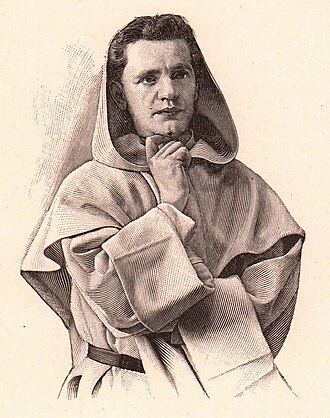
Antonin-Dalmace Sertillanges (1863–1948) — born Antonin-Gilbert — was a French Dominican friar, moral philosopher, and one of the most influential popularisers of Thomism in the early twentieth century. Born in Clermont-Ferrand, he entered the Order of Preachers in 1883 and was ordained a priest in 1888. He became professor of moral philosophy at the Institut Catholique de Paris and, in 1893, was among the founders of the Revue Thomiste, a journal that would become central to the renewal of studies on Thomas Aquinas. In 1918 he was elected to the Académie des sciences morales et politiques. Although he produced a substantial body of Thomist exegesis, his name reached a wide readership chiefly through a small book of 1921, La Vie intellectuelle (The Intellectual Life), which became an enduring classic on the discipline, the ethics, and the method of the work of the mind.
Central Ideas
- Intellectual work as a vocation (The Intellectual Life, 1921): to think and study seriously is neither mere technique nor a salaried trade, but a calling that engages the whole person — their morality, their discipline, and their spiritual life. The intelligence, for Sertillanges, is ordered toward truth, and to serve truth is itself a form of service.
- The “two hours a day” (The Intellectual Life, 1921): the book’s most far-reaching practical thesis. One need not be a full-time scholar; a person with another profession and other obligations can still build serious work by devoting a few hours daily to study — provided they are steady, protected, and well used.
- The body in the service of the spirit (The Intellectual Life, 1921): thought has physical conditions. Sleep, diet, exercise, and the rhythm of life are not accessories but prerequisites of sustained intellectual work.
- The art of reading (The Intellectual Life, 1921): read little, but read well; rank one’s reading, return to the great books, take notes, and train the memory, rather than scattering oneself across sheer quantity.
- Moral exegesis of Thomism (Saint Thomas d’Aquin, 1910): a systematic interpreter of Thomas Aquinas, Sertillanges expounded his metaphysics and moral philosophy, defending the harmony of faith and reason and the unity of knowledge under truth as the end of the intelligence.
Influenced by
- Thomas Aquinas — the central source of his philosophy and of the spirit of The Intellectual Life
- Aristotle — teleology and the doctrine of the virtues, received through the Thomist mediation
- The Dominican tradition and the movement of neo-Thomist renewal
Influenced
- Generations of students and researchers, inside and outside Catholic circles, through the discipline of study set out in The Intellectual Life
- The contemporary debate on attention, reading, and the life of the mind, which still turns to the book as a manual of method
Works
His scholarly reputation rested on a vast Thomist exegesis, above all Saint Thomas d’Aquin (2 vols., 1910). But it was La Vie intellectuelle: son esprit, ses conditions, ses méthodes (1921) — conceived as a free commentary on the counsels on study attributed to Thomas Aquinas — that secured him readers for more than a century. He also wrote Le Christianisme et les philosophies (2 vols., 1939–1941), Henri Bergson et le catholicisme (1941), and, in the year of his death, Ce que Jésus voyait du haut de la croix (1948).
See also
Thomas Aquinas, Bergson, Pascal