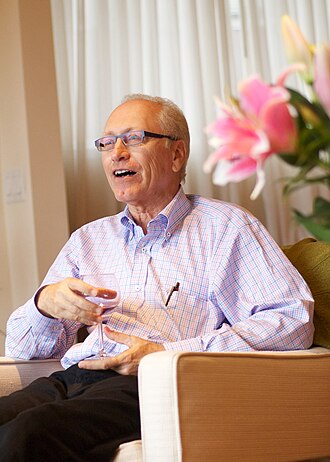
Andrew Feenberg was born in 1943 in the United States. He earned his PhD in philosophy from the University of California, San Diego, in 1972 under Marcuse, whose direct student he was during the final years of the exiled German philosopher’s career. As a student, Feenberg was actively involved with the New Left, founding the journal Alternatives and taking part, alongside Marcuse himself, in the May 1968 events in Paris — Marcuse, who was in the city for a UNESCO conference on Marx, was recognized by students occupying the École des Beaux-Arts and invited to address the assembly; Feenberg, who accompanied him, witnessed the episode and would, decades later, co-write with Jim Freedman the book When Poetry Ruled the Streets (2001), on that movement. He taught philosophy at San Diego State University from 1969 to 2003, with visiting appointments at Duke, SUNY Buffalo, the Sorbonne, the École des Hautes Études en Sciences Sociales, and the University of Tokyo, among other institutions. He later held the Canada Research Chair in Philosophy of Technology at Simon Fraser University in Vancouver, where he directed the Applied Communication and Technology Lab (ACT Lab) until becoming professor emeritus.
Over more than four decades, Feenberg’s work has developed a critical theory of technology that rejects both technological determinism — the idea that technology follows an autonomous developmental logic neutral with respect to values — and the substantivism inherited from Heidegger, for whom modern technology would embody a single, dominating essence. In Critical Theory of Technology (1991) and, more systematically, in Questioning Technology (1999), Feenberg proposed a two-level instrumentalization theory: primary instrumentalization, by which objects and processes are isolated from their natural context and reduced to manipulable functions (a moment common to all technology, including on the Heideggerian reading), and secondary instrumentalization, in which those functions are reintegrated into concrete social contexts, carrying choices of value, power, and culture not always visible in the artifact’s final design. It is precisely in secondary instrumentalization, for Feenberg, that the space for political contestation lies: the same technology can be configured in different ways depending on which social interests prevail in its development — hence his advocacy of the democratization of technology, that is, of broadening the participation of users, workers, and affected communities in technological design decisions, decisions today often concentrated in the hands of experts and corporations.
In Transforming Technology (2002) — a revised and expanded second edition of Critical Theory of Technology — and in Technosystem: The Social Life of Reason (2017), Feenberg deepened this critique in direct dialogue with Habermas, the Frankfurt School, and science and technology studies (STS), arguing that technical rationality is neither neutral nor univocal but ambivalent: it contains within itself possibilities for development that are both authoritarian and emancipatory, whose realization depends on concrete social struggles rather than on any ineluctable technological necessity.
Key Concepts
- Critical theory of technology: rejects both technological determinism and Heideggerian substantivism, holding that technology is an ambivalent social field, open to disputes over value and power.
- Primary and secondary instrumentalization: the distinction between the functional isolation of objects and processes (primary) and their reintegration into concrete social contexts, laden with value choices (secondary).
- Democratization of technology (democratic rationalization): the proposal to broaden the participation of users, workers, and affected communities in technological design decisions.
- Ambivalence of technology: the central thesis that technical rationality carries, at once, authoritarian and emancipatory possibilities, whose realization depends on social struggle rather than ineluctable necessity.
- Critique of the thesis of value-neutrality of technology, common to both instrumentalism and certain readings of technological determinism.
Influenced by
- Marcuse — Feenberg’s doctoral advisor at San Diego and the chief reference point of his entire body of work, especially Marcuse’s critique of technological rationality in Eros and Civilization and One-Dimensional Man
- Heidegger — a constant critical interlocutor; Feenberg both takes up and revises the Heideggerian analytic of technology, the central theme of Heidegger and Marcuse: The Catastrophe and Redemption of History (2005)
- Marx — the reading of technology as a field of social contestation and relations of production, rather than a neutral structure
- Georg Lukács — the theory of reification, the basis of Lukács, Marx and the Sources of Critical Theory (1981), Feenberg’s first book
- Habermas — dialogue on communicative rationality and social rationalization, taken up critically in later works
Influenced
- Critically oriented science and technology studies (STS), in dialogue — and at times in tension — with Bruno Latour’s actor-network theory
- Contemporary debates on participatory design and the democratization of digital platforms, which revive the distinction between primary and secondary instrumentalization
- The research community formed at Simon Fraser University’s Applied Communication and Technology Lab (ACT Lab), under his direction
- The contemporary reception of Marcuse and the Frankfurt School within the philosophy of technology
Works
Lukács, Marx and the Sources of Critical Theory (1981); Critical Theory of Technology (1991); Alternative Modernity (1995); Questioning Technology (1999); When Poetry Ruled the Streets (with Jim Freedman, 2001); Transforming Technology: A Critical Theory Revisited (2002); Heidegger and Marcuse: The Catastrophe and Redemption of History (2005); Between Reason and Experience: Essays in Technology and Modernity (2010); Technosystem: The Social Life of Reason (2017).
See also
Marcuse, Heidegger, Marx, Georg Lukács, Don Ihde, Albert Borgmann