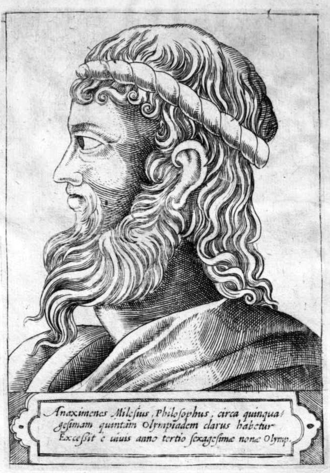
The third great name of the Milesian school, Anaximenes (c. 585–525 BCE) was a disciple of Anaximander. At first glance he took a step back, rejecting his master’s indeterminate apeiron and returning to a concrete element as the principle: air (aēr). But his choice carried a decisive advantage — air, being determinate, allowed him to explain how the single principle transforms into all things, something that neither Thales’s water nor the apeiron explained clearly.
This is his greatest discovery: the mechanism of condensation and rarefaction. As it rarefies, air becomes fire; as it progressively condenses, it turns into wind, cloud, water, earth, and finally stone. Thus all the qualitative differences of the world are reduced to quantitative differences of density of a single substance — an intuition of remarkable scientific fruitfulness, since it explains change by a physical process rather than by mere assertion.
For Anaximenes, air had an almost vital character. In one of the few preserved fragments, he draws the analogy between microcosm and macrocosm: just as our soul, which is air, holds us together and governs the body, so too air (or breath) envelops and sustains the entire cosmos. Although Aristotle would observe that, in seeking the universal, Anaximenes remained bound to a particular, his mechanism of transformation influenced Heraclitus and later Greek physics, bringing the founding Milesian triad to a fitting close. Though less famous than Thales or Anaximander, he was probably the most influential of the three in antiquity, precisely because he offered a concrete, observable mechanism to explain how a single substance turns into the manifold things of the world — a model echoed in later theories of matter. His emphasis on a single, all-pervading substance also lent itself to the lasting analogy between the breath that animates the living body and the air that enfolds the world.
Key Concepts
- Arché: air
- Condensation and rarefaction as mechanism of transformation
- Microcosm/macrocosm analogy (soul-air / cosmic air)
Influenced by
- Thales of Miletus
- Anaximander (direct teacher)
Influenced
- Heraclitus — idea of fire as transformation of air
- Diogenes of Apollonia — resumed air as principle
Works
Fragments in Simplicius and Theophrastus. Sources: Diogenes Laërtius, Lives, II.
See also
Pre-Socratics and Sophists