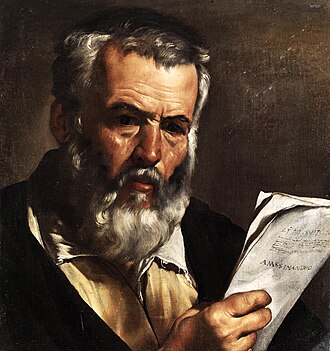
A fellow citizen and disciple of Thales of Miletus, Anaximander (c. 610–546 BCE) was one of the boldest minds of the Milesian school and perhaps the first thinker to write a prose treatise on nature. Tradition credits him with the pioneering use of the term arché (“principle”), as well as remarkable achievements: drawing the first map of the inhabited world and introducing the gnomon (sundial) into Greece.
Dissatisfied with Thales’s water, Anaximander proposed as the principle the apeiron — the boundless, indeterminate, and imperishable. No particular element could give rise to all the others without being consumed by them; only something indefinite and inexhaustible could be the eternal source of everything. From the apeiron, eternal and divine, the opposites (hot and cold, wet and dry) separate out, and from this separation worlds are born — which, in due time, return to it. The only surviving verbatim fragment, transmitted by Simplicius, speaks of this cosmology in moral terms: things “pay one another penalty and retribution for their injustice, according to the order of time.”
His cosmology is strikingly modern. The Earth, according to him, is a cylinder that floats freely at the center of the cosmos, needing no support — for, being equidistant from everything, there is no reason for it to fall one way rather than another. And, in a proto-evolutionary flash, he held that the first living beings arose from the moist element and that the human being descends from fish-like creatures. His ideas influenced Anaximenes, Heraclitus, and Pythagoras.
Key Concepts
- Apeiron: infinite/unlimited as principle
- Separation of contraries → injustice → return to apeiron
- Rudimentary biological evolution (man originated from aquatic animals)
Influenced by
- Thales of Miletus (teacher)
Influenced
- Anaximenes — attempted to determine the apeiron as air
- Heraclitus — idea of opposites
- Pythagoras — conception of the unlimited
Works
Sole surviving fragment (in Simplicius, Commentary on the Physics): “Things perish into those things from which they have their origin, according to necessity, for they pay one another penalty and retribution for injustice according to the order of time.”
See also
Pre-Socratics and Sophists