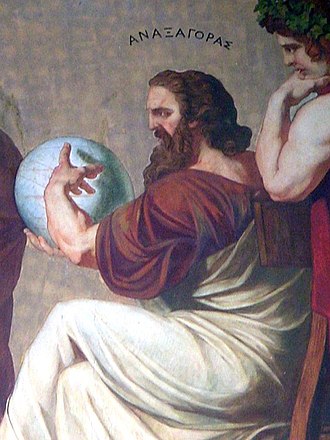
Born in Clazomenae, in Ionia, around 500 BCE, Anaxagoras was the first philosopher to bring the Ionian tradition to Athens, where he lived for some thirty years and became a friend and adviser of the statesman Pericles. His intellectual boldness cost him dearly: accused of impiety for holding that the Sun was not a god but an incandescent stone, he was put on trial and had to leave the city, taking refuge in Lampsacus.
Faced with the problem left by the Eleatics — how to explain change without admitting that something arises from nothing? — Anaxagoras proposed that “in everything there is a portion of everything.” Matter is composed of infinitely divisible seeds (homeomeries), and each thing contains particles of all the others; what distinguishes an object is only what predominates in it. Nothing comes to be or perishes absolutely: everything is mixture and separation.
His great innovation, however, was to introduce an ordering principle distinct from matter: the Nous (Intelligence or Mind). Unlike everything else, the Nous is pure, unmixed, and it was the Nous that set in motion the primordial whirlwind that separated the elements and organized the cosmos. This was the first time an intelligence appeared as the cause of the order of the world — an idea that excited Socrates (although in Plato’s Phaedo he lamented that Anaxagoras made little use of it) and that Aristotle would discuss critically.
Key Concepts
- Homeomeries: contrary to Empedocles, there are no basic elements in fixed number — every thing contains parts of all other things in varying proportion; “in everything there is a portion of everything”
- Infinite Divisibility: matter is infinitely divisible; there is no smallest part; every thing, however small, contains something of each quality
- Nous (Intelligence/Cosmic Mind): the only separated and pure principle; it is not mixed with anything; it is the force that initiated the primordial rotational movement that generated the cosmos. “Nous is infinite, self-sovereign and unmixed with anything”
- Cosmogony: in the beginning everything was mixed at rest; Nous initiated a whirlwind that progressively separated the dense/cold/dark from the rare/hot/luminous
- Rational Astronomy: Sun is an incandescent stone larger than the Peloponnese; the Moon reflects sunlight; eclipses have natural causes
Influenced by
- Parmenides — being neither comes to be nor perishes; Anaxagoras reinterprets change as mixture
- Heraclitus — universality of mobility and change
- Milesian School — search for a natural principle of the cosmos
Influenced
- Socrates — admired the concept of Nous but was disappointed by the limited use that Anaxagoras made of it (cf. Plato’s Phaedo)
- Aristotle — criticized Nous as deus ex machina; but recognized the importance of the concept
- Tradition of cosmological rationalism
Works
On Nature (fragments preserved by Simplicius and others).
See also
Pre-Socratics and Sophists