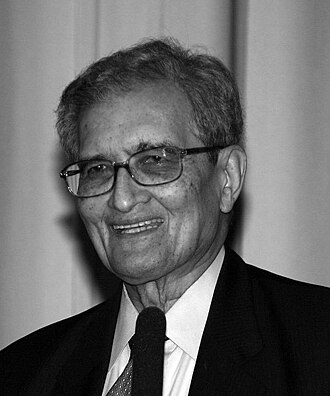
Amartya Sen (b. 1933, Santiniketan, Bengal) is an Indian economist and philosopher whose work has dissolved the border between economics and ethics. He received the Nobel Memorial Prize in Economic Sciences in 1998 for his contributions to social choice theory and welfare economics. A professor at Harvard, Sen studied in Calcutta and Cambridge and served as master of Trinity College. Marked in his youth by the Bengal famine of 1943 — which killed millions and in which he lost a relative — he devoted himself to understanding the causes of poverty and deprivation and to rebuilding the normative foundations of economics. In intellectual partnership with the philosopher Martha Nussbaum, he developed the capability approach. He received the Bharat Ratna, India’s highest civilian honour, in 1999.
Key Concepts
- Capability approach (Development as Freedom, 1999): the proper criterion for evaluating well-being and justice is neither GDP nor the possession of resources, but people’s capabilities — the real freedoms they have to lead the kinds of lives they have reason to value; income is only a means.
- Functionings and capabilities: functionings are concrete achievements — being well-nourished, being healthy, taking part in public life —; capabilities are the set of combinations of functionings a person can actually attain. Two people with equal incomes may have very unequal capabilities depending on age, gender, disability, or social context.
- Critique of utilitarianism and welfarism (Collective Choice and Social Welfare, 1970; On Ethics and Economics, 1987): reducing the good to pleasure or to satisfied preference ignores the adaptation of desires to deprivation (“adaptive preferences”) and disregards dimensions such as dignity, agency, and procedural freedom.
- Famine as a question of entitlements (Poverty and Famines, 1981): large-scale famine, in most cases, does not follow from an absolute fall in food supply, but from the collapse of entitlements — the legal and economic mechanisms by which groups can claim food; hence his thesis that mass famines do not occur in functioning democracies with a free press.
- Plural identity (Identity and Violence, 2006): every person belongs simultaneously to many communities (nation, religion, profession, class, gender, language); identitarian violence stems from reducing the individual to a single singular affiliation, and the defence of plural identities is itself a defence of freedom.
- Comparative, not transcendental justice (The Idea of Justice, 2009): against the Rawlsian ideal of identifying perfectly just institutions, Sen proposes a comparative theory — oriented towards reducing manifest injustices — inspired by the Scottish Enlightenment, especially Adam Smith and Condorcet.
Influenced by
- Adam Smith — sympathy, the impartial spectator, moral economy
- John Stuart Mill — utilitarianism and individual liberty
- Aristotle — eudaimonia, human flourishing
- Karl Marx — analysis of alienation and exploitation
- Joan Robinson — doctoral supervisor at Cambridge (thesis on the choice of techniques)
- Kenneth Arrow — social choice theory (decisive intellectual influence, not a supervisor)
- Piero Sraffa and Maurice Dobb — political economy at Cambridge
Influenced
- Martha Nussbaum — list of central capabilities, more Aristotelian approach
- John Rawls — critical dialogue on primary goods
- The Human Development Index (UNDP) — formulated with Mahbub ul Haq, 1990
- The movement for a “human well-being economics” and the critique of GDP
- Contemporary political philosophy on inequality and development
Works
Collective Choice and Social Welfare (1970) reformulated social choice theory after Arrow. Poverty and Famines: An Essay on Entitlement and Deprivation (1981) established his reputation as an economist of poverty. On Ethics and Economics (1987) reopened the dialogue between the two disciplines. Inequality Reexamined (1992) and Development as Freedom (1999) consolidated the capability approach. Identity and Violence: The Illusion of Destiny (2006) attacks identitarian reductionism. The Idea of Justice (2009) presents his mature political philosophy. The Argumentative Indian (2005) and Home in the World (2021), his memoirs, explore pluralism and Indian traditions of public reason.
See also
John Rawls, Adam Smith, Michael Sandel