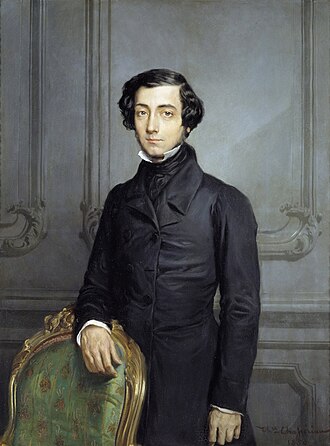
Alexis-Charles-Henri Clérel de Tocqueville was born in Paris on 29 July 1805 into a Norman aristocratic family, and died in Cannes on 16 April 1859. A magistrate by training, he traveled to the United States in 1831–1832 with Gustave de Beaumont, officially to study the American penitentiary system; the journey produced Democracy in America (De la démocratie en Amérique), whose first volume appeared in 1835 and second in 1840. He served as a deputy from 1839, was elected to the Académie française (1841), and was briefly Minister of Foreign Affairs in 1849. After Louis-Napoléon’s coup of 1851 he withdrew from political life and devoted himself to The Old Regime and the Revolution (1856). His memoirs, the Souvenirs, were published posthumously.
Tocqueville starts from the conviction that the advance of equality of conditions is a long-term, almost providential historical fact, and that the decisive question for modern societies is whether democracy will be joined to liberty or to new forms of servitude. His analysis combines empirical observation, comparative method, and a typology of social tendencies, and should not be reduced to either praise or condemnation of democracy.
Key Concepts
- Equality of conditions — the generative fact of modern democracy, understood by Tocqueville as a social state before a political regime; it shapes customs, ideas, and sentiments.
- Tyranny of the majority — the risk that popular sovereignty without counterweights imposes on minorities and individuals a pressure both legal and moral, affecting independence of mind itself.
- Democratic individualism — Tocqueville’s term for the citizen’s withdrawal into the private sphere, which makes him indifferent to public affairs and vulnerable to centralized power.
- Soft despotism — in the second volume of Democracy, he describes the possibility of a tutelary, benevolent, and meticulous power that reduces citizens to dependents without resorting to open violence.
- Associations and local life — civil associations, municipal autonomy, a free press, and the jury function as schools of liberty and antidotes to centralization.
- Religion and mores (moeurs) — Tocqueville assigns a central role to habits and beliefs in sustaining free institutions, above all in the United States.
- Continuity between Old Regime and Revolution — in 1856 he argues that the administrative centralization attributed to the Revolution was already advancing under the monarchy, so that the Revolution completed rather than broke with an earlier trend.
Interpretations and Criticism
Tocqueville is read as an aristocratic liberal, as a theorist of democracy, and as a forerunner of political sociology. Critics note that, although he condemned slavery and described with lucidity the fate of Native Americans and Black Americans in the United States, he defended the French conquest of Algeria in writings and reports of the 1840s, a stance critically analyzed by scholars such as Jennifer Pitts. Others ask whether his opposition between liberty and equality underrates the emancipatory potential of egalitarian demands, and whether his portrait of American democracy is representative of the country as a whole.
Influenced by
- Montesquieu — pluralism of political forms, intermediate bodies, and attention to mores
- Rousseau — an ambivalent interlocutor whose idea of popular sovereignty Tocqueville criticizes for its centralizing risks
- Blaise Pascal and François Guizot — respectively in moral anthropology and in the historical reading of the march of equality and of the middle classes
- Edmund Burke — affinity in defending intermediate bodies, though no direct discipleship is established
Influenced
- John Stuart Mill — reviewed Democracy in 1835 and 1840 and absorbed the concern with the tyranny of the majority in On Liberty
- Hannah Arendt — in On Revolution, engages Tocqueville on public freedom and the American experience
- Raymond Aron, who placed him among the founders of political sociology, and the contemporary literature on civil society and social capital
Works
De la démocratie en Amérique (vol. 1, 1835; vol. 2, 1840); L’Ancien Régime et la Révolution (1856); Souvenirs (published posthumously); writings on Algeria and correspondence.
See also
Montesquieu, Edmund Burke, John Stuart Mill, Hannah Arendt, Friedrich Hayek