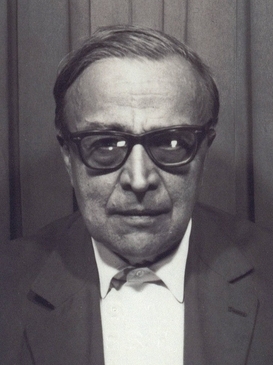
Alexandre Kojève, born Aleksandr Vladimirovich Kozhevnikov, was born in Moscow on 28 April 1902 and died in Brussels on 4 June 1968, shortly after addressing officials and representatives of the European Economic Community on behalf of the French government. He left Russia after the revolution, studied in Germany and took his doctorate at Heidelberg in 1926 under Karl Jaspers, with a thesis on the religious philosophy of Vladimir Solovyov. He settled in Paris, where, at the request of Alexandre Koyré, he took over in 1933 the course on Hegel at the École pratique des hautes études. After the war he worked in the French Ministry of Economic Affairs and took part in planning what became the European Economic Community, so that his life combined philosophical teaching with a long career as a senior civil servant.
His name is tied to the seminar he gave from January 1933 to May 1939 as a commentary on Hegel’s Phenomenology of Spirit. Its audience included Raymond Aron, Georges Bataille, André Breton, Jacques Lacan, Maurice Merleau-Ponty and Raymond Queneau. Queneau edited the course notes, published by Gallimard in 1947 as Introduction à la lecture de Hegel, a book that became the main route by which a generation of French intellectuals approached Hegelianism.
Key Concepts
- Anthropological reading of Hegel — Kojève interprets the Phenomenology as a philosophy of the human being, who is constituted through action and the negation of the given. His reading is filtered through Marx and Heidegger, and is often criticized for privileging certain chapters (above all the dialectic of master and slave) and for downplaying Hegel’s logic and the idea of Spirit.
- Desire for recognition and the master-slave dialectic — properly human desire is the desire for another’s desire, that is, to be recognized. The life-and-death struggle for recognition gives rise to the relation of master and slave; for Kojève it is the slave, through labour, who transforms the world and himself, and history advances through this process.
- End of history — Kojève holds that history, understood as the process of struggles for recognition, reaches its end when a “universal and homogeneous” state arises in which all are recognized. He places a decisive turning point in the French Revolution and Napoleon, from Hegel’s standpoint at Jena, and later discussed in what sense the contemporary world is “post-historical.” The thesis does not mean the end of events but the exhaustion of conflict over the principles of recognition.
- Wisdom and philosophy — Kojève holds that the Absolute Knowledge reached by Hegel closes philosophy as the pursuit (love) of wisdom and turns it into wisdom.
- Debate with Leo Strauss — in the essay “Tyranny and Wisdom”, Kojève’s response to Strauss’s On Tyranny, to which Strauss replied with a “Restatement”, the debate discusses whether the philosopher should intervene in politics (Kojève’s position) or whether philosophy and politics are fundamentally opposed (Strauss’s position).
Influenced by
- Hegel — the central source, read in an anthropological and historical key
- Karl Marx — the primacy of labour and struggle in history
- Martin Heidegger — finitude, death and negativity, themes of Being and Time
- Alexandre Koyré — his predecessor in the Hegel course and an intellectual interlocutor
- Karl Jaspers and Vladimir Solovyov — his Heidelberg training and doctoral thesis
Influenced
- Jacques Lacan — the theme of desire and recognition (desire of the Other)
- Francis Fukuyama — took the idea of the end of history and of the struggle for recognition from Kojève in “The End of History?” (1989) and The End of History and the Last Man (1992), with important modifications
- Georges Bataille, Raymond Queneau and Maurice Merleau-Ponty — seminar auditors whose reception of Hegel passed through Kojève
- Twentieth-century French Hegelianism and the debate on the philosophy of history
Works
Introduction à la lecture de Hegel (1947); Esquisse d’une phénoménologie du droit (written 1943, published 1981); Essai d’une histoire raisonnée de la philosophie païenne (3 vols., 1968–1973); Kant (1973); L’Athéisme (published 1998); La Notion de l’autorité (published 2004).
See also
Hegel, Francis Fukuyama, Marx, Heidegger, Leo Strauss, Jacques Lacan, Merleau-Ponty, Karl Jaspers, Vladimir Solovyov