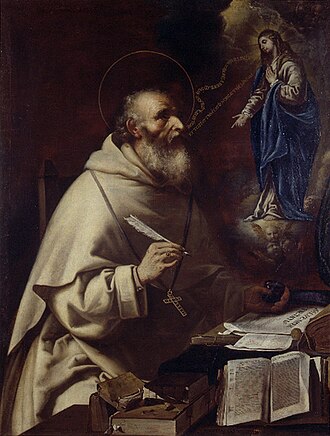
Dominican friar, Bishop of Regensburg, and Doctor Universalis. He was the teacher of Thomas Aquinas and the principal figure responsible for the systematic introduction of Aristotle into the medieval Latin world. Unlike other scholastics, Albert had a genuine interest in the natural sciences — botany, zoology, mineralogy, alchemy — combining empirical observation with philosophical reflection. Canonized and declared Doctor of the Church in 1931, he is the patron saint of natural scientists.
Born in Lauingen, in Swabia, Albert joined the newly founded Order of Preachers and taught in several Dominican convents before reaching the University of Paris, where he held a chair of theology as regent master. In 1248 he was sent to Cologne to organize the order’s studium generale, and it was there that he had Thomas Aquinas among his students. His career spanned a decisive moment: the massive arrival in the West of Aristotle’s works, rendered from Greek and Arabic, aroused as much enthusiasm as ecclesiastical suspicion, and Albert took on the task of making this corpus intelligible and compatible with Christian faith without mutilating it.
The heart of his project lies in distinguishing the domains of knowledge without opposing them. For Albert, the investigation of nature must proceed through its own causes, observation, and reason, whereas theology departs from revelation; confusing the two methods impoverishes both. This conviction led him to roam fields and mines in person and to examine plants and animals, recording what he saw even when it contradicted established authorities — an attitude that prefigures the later empirical spirit. His influence was immense: he supplied Thomas Aquinas with the Aristotelian framework that the latter would deepen, nourished the Rhineland mysticism of Meister Eckhart, and bequeathed to the Middle Ages a model of the philosopher-naturalist who unites bookish learning with direct experience.
Key Concepts
- Reception of Aristotle: commented on and paraphrased virtually the entire Aristotelian corpus available in Latin (via Arabo-Latin translations), making it accessible to the Christian West
- Relative autonomy of philosophy: argued that natural philosophy has its own methods, distinct from theology — reason investigates nature, faith contemplates revelation
- Empirical natural sciences: conducted his own observations in botany (De Vegetabilibus), zoology (De Animalibus), and mineralogy (De Mineralibus), criticizing traditions when they contradicted experience
- Reconciliation of faith and reason: like Thomas Aquinas after him, maintained that faith and reason do not contradict each other, though they operate in distinct domains
- Arabic influence: critically assimilated Avicenna and Averroes, mediating the reception of Aristotelianism in the West
Influenced by
- Aristotle — philosophical system and natural sciences
- Avicenna — metaphysics and the distinction between essence and existence
- Averroes — commentaries on Aristotle
- Pseudo-Dionysius — mystical theology
Influenced
- Thomas Aquinas — direct disciple; continued and deepened the Aristotelian-Christian project
- Duns Scotus — later scholastic debates
- Meister Eckhart — Rhineland mysticism (Dominican student in Albert’s tradition)
- The tradition of natural sciences in the Middle Ages
Works
De Animalibus (26 books); De Vegetabilibus (7 books); De Mineralibus (5 books); Summa Theologiae (unfinished); De Unitate Intellectus (against Averroism); commentaries on Aristotle’s Ethics, Politics, Physics, and Metaphysics.
See also
Medieval Philosophy