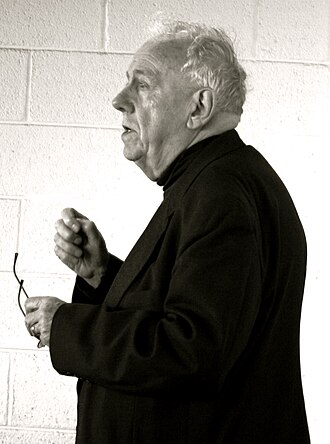
Alasdair MacIntyre (1929–2025) was a Scottish-American moral philosopher, the author of one of the most influential works of twentieth-century moral philosophy, After Virtue (1981). His intellectual career was marked by a long pilgrimage: he set out from Marxism in his youth, passed through several positions, and ultimately converted to Catholicism and to Aristotelian Thomism in his maturity. He died in May 2025. MacIntyre diagnosed modern moral language as being in a state of grave disorder — composed of decontextualised fragments of traditions that have been lost — and argued that the “Enlightenment project” of providing an autonomous rational justification for morality had failed, clearing the way for emotivism. His proposal was the recovery of a virtue ethics of Aristotelian-Thomist roots, anchored in communal life and in traditions of enquiry.
Key Concepts
- The disorder of modern morality (After Virtue, 1981): contemporary moral language preserves only fragments of older conceptual schemes, stripped of the context that gave them meaning; hence the interminable and seemingly irresolvable moral disagreements of modern culture.
- Failure of the Enlightenment project (After Virtue, 1981): the attempts of Hume, Kant, Kierkegaard, and others to justify morality without recourse to a teleological conception of human nature were bound to fail, since they discarded the end (telos) that had articulated the moral rules.
- Practice and internal goods (After Virtue, 1981): a practice is a cooperative, socially established human activity whose internal goods can be achieved only by taking part in it according to its standards of excellence; the virtues are the dispositions that enable us to attain them.
- The narrative unity of a life (After Virtue, 1981): human life has the form of a narrative, and the question of the good is the question of what confers unity and meaning on a whole life conceived as a quest.
- Tradition as the context of rationality (Whose Justice? Which Rationality?, 1988): there is no neutral, ahistorical rationality; rational enquiry into justice and the good always takes place within concrete historical traditions, which can be compared by their capacity to overcome their internal crises.
- Dependent rational animals (Dependent Rational Animals, 1999): against the image of the autonomous, self-sufficient agent, MacIntyre stresses vulnerability, disability, and dependence as central conditions of human life, together with the “virtues of acknowledged dependence”.
Influenced by
- Aristotle — teleology, the virtues, and eudaimonia
- Thomas Aquinas — the Aristotelian-Christian synthesis of his maturity
- Marx — the social critique of the young MacIntyre
- Elizabeth Anscombe — “Modern Moral Philosophy” and the return to virtue
Influenced
- Charles Taylor — communitarianism and the critique of the disengaged self
- Michael Sandel — the liberalism/communitarianism debate
- Stanley Hauerwas — theological virtue ethics
- Contemporary neo-Aristotelian moral philosophy in general
Works
The work that established his reputation was After Virtue: A Study in Moral Theory (1981), followed by a trilogy that deepened and historicised his theses: Whose Justice? Which Rationality? (1988), on the dependence of rationality upon traditions, and Three Rival Versions of Moral Enquiry (1990), which confronts encyclopaedia, genealogy, and tradition. Dependent Rational Animals: Why Human Beings Need the Virtues (1999) incorporates embodiment and vulnerability into his Aristotelianism. Before this turn he had written works of history and criticism, among them A Short History of Ethics (1966).
See also
Aristotle, Thomas Aquinas, Bernard Williams