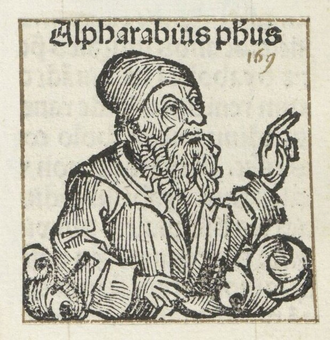
Abū Naṣr Muḥammad ibn Muḥammad al-Fārābī (c. 872–c. 950) was one of the greatest philosophers of the medieval Islamic world, called by the tradition “the Second Teacher” (al-Muʿallim al-Thānī) — the first being Aristotle. Born in the region of Farab (present-day Kazakhstan/Uzbekistan), he worked principally in Baghdad and Aleppo under the patronage of the Hamdanid court. His work spans logic, political philosophy, metaphysics, philosophy of music, and theory of the sciences.
Key Concepts
The Virtuous City (Al-Madīna al-Fāḍila, “The Opinions of the Inhabitants of the Virtuous City”): A political work modelled on Plato’s Republic and Laws, integrated with Neoplatonic cosmology and Islamic thought. The virtuous city is that whose citizens share the correct opinions and actions that lead to true happiness. The ideal ruler is simultaneously philosopher and prophet — uniting intellectual perfection and the ability to communicate truth to the majority through images and symbols (the function of religion).
Theory of the Intellect: Al-Farabi distinguishes several levels of intellect (an influential development in the later Arabic and scholastic tradition):
- Material intellect (in potency): capacity to receive intelligible forms
- Habitual intellect: acquired capacity to understand
- Actual intellect: actualisation of knowledge
- Acquired intellect: the most perfect form, in contact with the Agent Intellect
- Agent Intellect (ʿAql al-Faʿʿāl): a separate cosmic intellect that illuminates human intellects, identified with the Moon (the tenth intellect in Al-Farabi’s Ptolemaic-Neoplatonic cosmology)
Emanationist Cosmology: Al-Farabi adapts Neoplatonic emanation (Plotinus) to Aristotelian-Ptolemaic cosmology: from the First (the One/God) ten separate intellects emanate, each corresponding to a celestial sphere. From the tenth intellect (Agent Intellect) emanates the sublunary world — including souls and the forms of matter.
Harmony of Plato and Aristotle (Kitāb al-Jamʿ bayna raʾyay al-Ḥakīmayn): Al-Farabi argued that Plato and Aristotle, despite apparent divergences, reached the same essential conclusions. This thesis of concordance was influential but much contested: critics point out that Al-Farabi frequently subordinates one to the other rather than genuinely identifying them.
Logic as a Universal Instrument (Iḥṣāʾ al-ʿUlūm — “Enumeration of the Sciences”): Al-Farabi proposes logic as an instrument (organon) applicable to all sciences, not merely to philosophy. His encyclopaedia of the sciences is one of the first projects of systematic classification of knowledge in the Islamic tradition.
Theory of Music (Kitāb al-Mūsīqā al-Kabīr, “The Great Book of Music”): One of the most comprehensive treatises on music theory in the medieval world. Al-Farabi systematises scales, rhythms, instruments, and the relation between mathematics and sound, combining Pythagorean and Greek influence with the musical practices of the Arab world.
Influenced by
- Aristotle — logic, metaphysics, ethics, politics
- Plato — political philosophy and theory of forms
- Plotinus and Neoplatonism — emanation and theory of the One
- Porphyry and Iamblichus — late Neoplatonism
Influenced
- Avicenna (Ibn Sina, 980–1037) — Al-Farabi introduced him to Aristotle’s Metaphysics
- Averroes — Aristotelian commentaries
- Maimonides — philosophical-religious integration
- Latin Scholasticism (Albert the Great, Thomas Aquinas) — via Latin translations
Works
Al-Madīna al-Fāḍila (The Virtuous City); Iḥṣāʾ al-ʿUlūm (Enumeration of the Sciences); Kitāb al-Mūsīqā al-Kabīr (The Great Book of Music); Kitāb al-Jamʿ (Harmony of Plato and Aristotle); Risāla fī ʿAql (Treatise on the Intellect); commentaries on Aristotelian logic.
See also
Medieval Philosophy
Recommended books:
 Al-Farabi on the Perfect State — R. Walzer (trans.)
Ver na Amazon →
Al-Farabi on the Perfect State — R. Walzer (trans.)
Ver na Amazon →