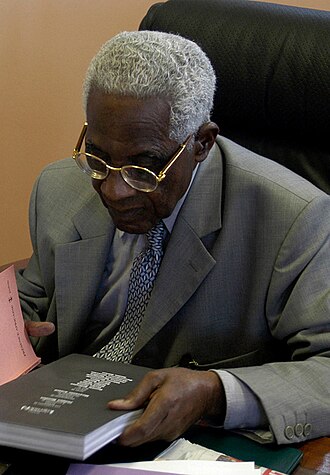
Aimé Fernand David Césaire (26 June 1913, Basse-Pointe, Martinique — 17 April 2008, Fort-de-France) was a poet, playwright, and politician, one of the founding voices of twentieth-century anticolonial thought. A student at the École Normale Supérieure in Paris (1935 cohort), it was there, in the vibrant milieu of black students from the French colonies, that he helped forge — alongside the Senegalese Léopold Sédar Senghor and the Guianese Léon-Gontran Damas — the Négritude movement. Later elected mayor of Fort-de-France (1945–2001) and a deputy in the French National Assembly, he was one of the architects of the 1946 law that turned Martinique into an overseas department — a decision he would later reassess critically. He was also Frantz Fanon’s teacher at the Lycée Schœlcher.
Key Concepts
- Négritude: the term Césaire coined around 1935, in the journal L’Étudiant noir, and which would receive its celebrated poetic expression in the poem Cahier d’un retour au pays natal (Notebook of a Return to the Native Land, 1939). It names the refusal of the cultural assimilation imposed by France and the positive affirmation of black identity and African heritage. For Césaire — closer to surrealist poetics than to Senghor’s systematic theorizing — Négritude is above all an act of reclaiming oneself: “my negritude is not a stone… it plunges into the red flesh of the soil.”
- Colonialism as mutual dehumanization (Discours sur le colonialisme, 1950): the essay’s central thesis is that colonization civilizes no one — on the contrary, it “decivilizes” the colonizer, brutalizes him, awakens in him violence and racism. Césaire draws a shocking continuity between colonialism and Nazism: what Europe could not forgive Hitler was not the crime itself, but having applied it to Europeans, with methods previously reserved for colonized peoples (the “boomerang effect” of colonial barbarism).
- Critique of European pseudo-universality: Césaire denounces a “civilization” that proclaims universal values while practicing plunder and massacre. He opposes to European universalism not a closed particularism but a concrete universal, “the repository of all that is particular.”
- Break with French communism (Lettre à Maurice Thorez, 1956): Césaire broke with the French Communist Party, accusing it of paternalism and of subordinating the colonial and racial question to the European class struggle, thereby denying the specificity of the situation of colonized peoples.
- Theatre of decolonization: in plays such as La Tragédie du roi Christophe (1963), Une saison au Congo (1966), and Une tempête (1969, an anticolonial reworking of Shakespeare’s The Tempest, in which Caliban rebels against Prospero), Césaire brought to the stage the dilemmas of power, liberation, and postcolonial identity.
Influenced by
- Léopold Sédar Senghor — founding partnership of Négritude
- Surrealism (André Breton, who prefaced the Cahier) — the poetic language of liberation
- Leo Frobenius — ethnology that valued African civilizations
- Karl Marx — analysis of exploitation (critically absorbed)
- The tradition of African-American literature (Harlem Renaissance)
Influenced
- Frantz Fanon — his student in Martinique
- Decolonial thought and postcolonial studies
- Édouard Glissant and the theory of créolité (by contrast and continuity)
- African and Caribbean independence movements
- Contemporary critique of colonialism (Achille Mbembe)
Works
Cahier d’un retour au pays natal (1939; definitive ed. 1956); Les Armes miraculeuses (poetry, 1946); Discours sur le colonialisme (1950); Lettre à Maurice Thorez (1956); La Tragédie du roi Christophe (1963); Une saison au Congo (1966); Une tempête (1969).
See also
Léopold Sédar Senghor, Frantz Fanon