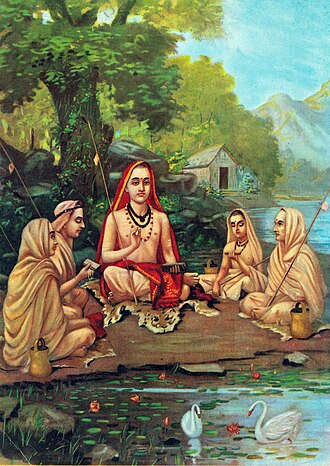
Note on dating: The dates of Ādi Śaṅkara (also spelled Shankara; honorifically Śaṅkarācārya, “the teacher Śaṅkara”) are disputed. Tradition places him at 788–820 CE, but many modern scholars prefer an earlier dating, around c. 700–750 CE. His biography became interwoven with hagiographical material, so that many episodes of his life belong more to legend than to verifiable historical record.
Śaṅkara is the most influential systematizer of Advaita Vedānta, the “non-dualist” current of Hindu philosophy. His work consists chiefly of rigorous commentaries on the canonical texts, in which he defends a metaphysics where the multiplicity of the world is ultimately reducible to a single reality. His influence on later Indian thought — and on the Western reception of Hinduism — is immense.
Key Concepts
Non-dualism (advaita, “not-two”): the central thesis that ultimate reality is one, without a second. The distinctions between subject and object, soul and world, are, at the absolute level, apparent rather than fundamental.
The identity of Brahman and Ātman: Brahman is absolute, infinite reality without attributes (nirguṇa); Ātman is the innermost “self” of each being. For Śaṅkara the two are identical — the individual self is neither a part of Brahman nor merely like it, but is Brahman, and the perception of separation is the product of ignorance. The great Upaniṣadic dictum “tat tvam asi” (“that thou art”) condenses this identity.
Māyā and the two levels of truth: the world of multiplicity is not simply false but has the status of māyā — an appearance that is real at the conventional level and unreal at the absolute level. Śaṅkara distinguishes conventional truth (vyavahārika), valid for practical life and empirical knowledge, from absolute truth (pāramārthika), in which Brahman alone is real.
Ignorance (avidyā): the cause of error and suffering is ignorance — the mistaken superimposition (adhyāsa) that takes the not-self for the self and the apparent for the real. It is avidyā that projects multiplicity onto unity.
Liberating knowledge (jñāna): liberation (mokṣa) is attained neither through ritual action nor through the accumulation of merit, but through direct knowledge of the identity of Ātman and Brahman. Since the truth is already the case, liberation is the recognition of what one has always been rather than a fresh acquisition.
Brahman without attributes (nirguṇa Brahman): at its highest level Brahman is indeterminate, beyond any positive predication. Theistic descriptions of a personal god with attributes (saguṇa Brahman) belong to the conventional level and serve as a stepping-stone, not as ultimate truth.
Influenced by
- The Upaniṣads — the primary textual and doctrinal source of non-dualism
- The Brahma Sūtras (attributed to Bādarāyaṇa) — the aphoristic systematization of Vedānta that Śaṅkara comments upon
- Gauḍapāda — a predecessor whose Māṇḍūkya Kārikā anticipates Advaita theses; tradition links him to Śaṅkara as the teacher of his teacher
Influenced
- The later Advaita tradition — disciples such as Sureśvara and Padmapāda, and the whole subsequent school
- Rāmānuja (11th–12th century) — develops the “qualified non-dualist” Vedānta (Viśiṣṭādvaita) in direct criticism of Śaṅkara
- Modern Neo-Vedānta — Vivekananda and the Western reception of Hinduism rely heavily on his reading
- Comparative philosophy — discussed parallels with idealism and monism in Western metaphysics
Works
Śaṅkara’s most securely authentic and central works are his commentaries (bhāṣya): the Brahmasūtrabhāṣya (commentary on the Brahma Sūtras), regarded as his masterwork, along with commentaries on the principal Upaniṣads and the Bhagavad Gītā. Among the independent treatises, the Upadeśasāhasrī (“A Thousand Teachings”) is generally accepted as genuinely his. Several popular texts attributed to Śaṅkara — such as the Vivekacūḍāmaṇi (“The Crest-Jewel of Discrimination”) — have their authorship contested by a large portion of scholars, who consider them probably later. It is therefore important to distinguish the secure authorial core from the wide body of material attributed to him by tradition.
See also
Eastern Philosophy; Buddha; Confucius