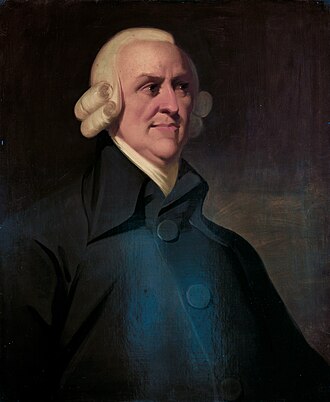
Scottish moral philosopher and economist, considered the father of modern political economy. A central figure of the Scottish Enlightenment and close friend of Hume. His work combines sentiment-based ethics with market theory.
Before he became known as a theorist of economics, Smith was a professor of moral philosophy at the University of Glasgow, and it is from that chair that the core of his thought takes shape. In The Theory of Moral Sentiments (1759) he begins with a characteristically Enlightenment question: how do beings driven by their own interests come to make moral judgments and to care about others? His answer lies in sympathy — not a feeling of pity, but the capacity to imagine oneself in another’s situation — and in the “impartial spectator,” an inner tribunal that leads us to judge our own conduct as a well-informed and disinterested observer would. For Smith, morality derives neither from abstract reason nor from external commandments, but from this web of mutual affections and reciprocal judgments that sustains social life.
That same outlook runs through The Wealth of Nations (1776), the fruit of long years of study and of a stay in France, where Smith came into contact with the Physiocrats. Far from glorifying greed, the work investigates how institutions, laws, and the play of exchange can turn individual interest into general prosperity — provided they are shielded from capture by monopolies and privileges. The apparent tension between the emphasis on sympathy in 1759 and on self-interest in 1776 became known as “the Adam Smith problem”; most contemporary interpreters regard it as spurious, reading the two works as facets of a single project on the social order. His influence on classical economics, on liberalism, and on later debates about markets and justice remains unavoidable to this day.
Key Concepts
- Invisible hand: individuals’ self-interest, channeled through the market, generates collective benefit without central planning — a metaphor for the spontaneous order of the price system
- Division of labor: specialization of tasks multiplies productivity; the classic example of the pin factory
- Labor theory of value: the value of commodities ultimately derives from the labor embodied in their production
- Moral sympathy: the foundation of ethics — the capacity to put oneself in another’s position and evaluate actions from the perspective of an “impartial spectator”
- Impartial spectator: an imaginary figure representing balanced moral judgment, detached from self-interest
- Critique of mercantilism: a nation’s wealth is not the accumulation of precious metals, but its productive capacity and free exchange
- Free market and laissez-faire: defense of competition and criticism of monopolies, corporate privileges, and arbitrary state interventions
Influenced by
- Hume — moral sentimentalism and skepticism about state intervention
- Francis Hutcheson — ethics of moral sense (his professor at Glasgow)
- Locke and Montesquieu — liberal political theories
- Mandeville — paradox of private vices / public benefits
Influenced
- Ricardo and Mill — classical economics
- Marx — inherited (and critiqued) the labor theory of value
- Bentham — utilitarianism and calculation of collective well-being
- Modern economic liberalism and neoliberalism (Hayek, Friedman)
Works
The Theory of Moral Sentiments (1759); The Wealth of Nations (1776).
See also
Contractualism, Enlightenment and Kant