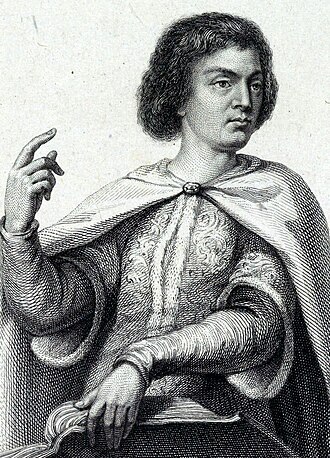
The most brilliant and controversial intellectual of the 12th century. Also famous for his tragic love affair with Heloise (castrated by order of her uncle). He proposed conceptualism in the dispute over universals and introduced dialectical reason into theology. “I understand in order to believe” — reason must examine before accepting by faith (an inversion of Anselm of Canterbury).
Born in Brittany into a family of the minor nobility, Abelard renounced his military inheritance to devote himself to the liberal arts, becoming an itinerant master who drew crowds of students to the schools of Paris. His career spans the decisive moment when teaching ceased to be a monopoly of the monasteries and migrated to the urban schools, foreshadowing the medieval university. A tireless polemicist, he challenged his own teacher William of Champeaux over the universals and later found himself in open conflict with the monastic authority embodied by Bernard of Clairvaux, who saw in his confidence in reason a danger to faith. This tension between dialectic and the contemplative tradition marks his entire body of work and helps explain the condemnations he suffered at ecclesiastical councils.
At the heart of his method lies the conviction that the apparent contradiction among Christian authorities — Scripture, the Church Fathers, the councils — should not be concealed but exposed and examined by reason. In the prologue to Sic et Non, Abelard sets out rules for reconciling divergent texts: attend to the meaning of words, distinguish what is said by concession from what is said by precept, and consider the context of each statement. Applied to theology, this critical stance made him one of the founders of the scholastic method, later systematized in the summae. His ethics of intention, which shifts moral judgment from the outward act to the inner consent of conscience, anticipated central debates in moral philosophy and secured him a lasting place in the history of thought, well beyond the romantic legend of his correspondence with Heloise.
Key Concepts
- Conceptualism (universalia post rem): universals are abstract concepts in the mind, neither real things separate from particulars (Plato) nor mere names (Roscellinus)
- Sic et Non: dialectical method — 158 theological questions answered with contradictory authorities; reason must resolve the contradiction
- Morality of intention: the act is neutral; good/evil resides in conscious intention
- Distinction: understanding (reason + faith) vs. comprehension (exclusive gift of God)
Influenced by
- William of Champeaux (the exaggerated realism of universals, refuted by Abelard)
- Boethius — Aristotelian logic
Influenced
- Thomas Aquinas — scholastic method of questions and solutions; ethics of intention
- Modern ethics of conscience and intention
Works
Sic et Non; Ethics or Know Thyself; Story of My Misfortunes (Historia Calamitatum).
See also
Medieval Philosophy