This is the third of five articles on Joseph Maréchal’s Le point de départ de la métaphysique. In the first two articles, we followed Maréchal’s historical survey from the ancient Greek tradition through medieval Scholasticism (Cahier I) and then through the modern conflict between rationalism and empiricism (Cahier II). That survey ended with Hume’s devastating skepticism — the revelation that neither the rationalist appeal to innate ideas nor the empiricist appeal to sense experience could ground the objective necessity that genuine knowledge requires. In this third article, we turn to Cahier III, which Maréchal devotes entirely to Immanuel Kant’s Critique of Pure Reason — the most ambitious attempt in modern philosophy to answer Hume’s challenge, and the text that casts the longest shadow over Maréchal’s entire project.
Why Kant Cannot Be Avoided
For a Catholic philosopher writing in the early twentieth century, engaging deeply with Kant was not self-evident. Many Thomists of the period treated Kant as simply an enemy to be refuted — the architect of a philosophy that closed the door on metaphysics and thereby on natural theology. Maréchal took a different approach, and it is one of the things that makes his work genuinely important.
Maréchal believed that a serious dialogue with Kant was not merely intellectually honest — it was philosophically necessary. Kant had raised the question of the conditions of the possibility of knowledge in a way that could not be brushed aside. Any philosophy that wished to claim objective knowledge of being had to engage with the critical question: not merely what do we know, but how is objective knowledge possible at all? To answer this question by simply ignoring Kant — by pretending the critical turn had not happened — was, for Maréchal, a form of philosophical evasion.
Cahier III is therefore not a polemic against Kant. It is a work of genuine philosophical reconstruction, aimed at understanding the Critique of Pure Reason from the inside before proposing any alternatives. Maréchal’s reading is remarkably sympathetic: he presents Kant as a thinker who correctly identified the problem of objectivity and made a decisive advance toward solving it, while arguing that Kant’s own solution contained a latent tension that could — and should — be resolved in a direction that Kant himself refused to take.
The Copernican Revolution
The organizing principle of the Critique of Pure Reason is what Kant himself called his “Copernican revolution” in philosophy. Just as Copernicus proposed that it is the earth that moves around the sun rather than the sun around the earth, Kant proposed that it is the knowing subject that imposes its forms and categories on experience rather than the knowing subject passively receiving the structure of a mind-independent world.
The motivation for this revolutionary proposal is precisely the problem Hume posed. If the mind were purely passive — a blank slate receiving impressions from outside — it would have no way of arriving at the necessary and universal connections that science requires. Experience can tell us what has happened; it cannot tell us what must happen. The necessity and universality that characterize genuine knowledge — mathematical truths, the law of causality, the principles of natural science — cannot come from the receptive side of knowledge. They must come from the mind itself.
Kant’s critical philosophy is, therefore, a systematic investigation of what the mind contributes to knowledge — what structures and forms the mind a priori imposes on the raw material of experience. This investigation proceeds in three major sections of the Critique: the Transcendental Aesthetic, the Transcendental Analytic, and the Transcendental Dialectic.
The Transcendental Aesthetic: Space and Time as Forms of Sensibility
The Transcendental Aesthetic addresses the most fundamental level of cognition: sensibility, the capacity to receive sensory data. Kant’s central claim here is that space and time are not features of things as they are in themselves, but forms of sensibility — the a priori structures through which the mind organizes the raw input of sensation.
The argument proceeds by a kind of transcendental isolation. Kant invites us to abstract from any sensible experience everything that belongs to sensation proper (colors, sounds, textures) and ask what remains as a pure residue. What remains, he argues, is the sheer spatial and temporal frameworks within which sensations are located: the pure intuitions of space and time. These frameworks cannot themselves be derived from experience, because all experience already presupposes them; they are therefore a priori — given by the mind, not received from the world.
The consequences are significant. If space and time are forms of our sensibility, then mathematics (whose objects are constructed in pure intuition of space and time) achieves its necessity and universality precisely because it describes the forms of our own cognitive apparatus — not features of a mind-independent reality. Mathematical truths are necessarily true for all possible experience, but only for experience as constituted by human sensibility. Whether they hold of things as they are in themselves — of the noumenon — is a question that cannot be answered.
Maréchal appreciates the power of this argument: it explains the necessity of mathematics without resorting to the rationalist appeal to innate ideas while also explaining why mathematics applies to experience without resorting to the empiricist appeal to induction. But he also marks the first critical question: if space and time are merely forms of our sensibility, then we have already committed ourselves to a picture in which the knowing mind does not reach things as they are in themselves — and the question of the correspondence between appearance and reality becomes permanently suspended.
The Transcendental Analytic: Categories and Schematism
If the Aesthetic deals with sensibility, the Transcendental Analytic deals with understanding (Verstand) — the faculty of thought proper. Kant’s central achievement in the Analytic is the deduction and justification of the pure concepts of understanding, or categories.
The categories are the a priori concepts through which the understanding synthesizes and orders the manifold of intuition. Kant derives them systematically from the table of logical forms of judgment: just as there are different forms of judgment (universal/particular/singular, affirmative/negative/infinite, categorical/hypothetical/disjunctive, problematic/assertoric/apodictic), so there are corresponding categories of thought (unity, plurality, totality; reality, negation, limitation; substance, causality, community; possibility, existence, necessity). Among these, causality is the most philosophically consequential: it is the category through which the understanding connects events in time as cause and effect, giving natural science its necessary structure.
But here a fundamental problem arises: the categories are pure concepts of the understanding, while the data they are meant to organize are sensible intuitions. How can pure concepts apply to sensible data at all? This is the problem that the Transcendental Schematism is designed to solve. Kant argues that time — the form of inner sense — serves as the mediating element between the purely intellectual categories and sensible intuition. Each category receives a schema — a rule for its temporal application — that allows it to be applied to the data of experience. The schema of causality, for example, is temporal succession according to a rule: when we apply the category of causality to experience, we are asserting that whenever an event of type A occurs, an event of type B will regularly follow in time.
The schematism is one of the most difficult and contested passages in the Critique, but Maréchal engages with it in detail because it is philosophically crucial. The schematism ensures that the categories have legitimate application only within the bounds of possible experience — only where sensible intuition can supply the temporal framework within which they operate. This is the formal basis for Kant’s restriction of theoretical knowledge to the realm of phenomena.
The Transcendental Dialectic: The Illusions of Reason
The Transcendental Aesthetic and Analytic together establish the domain of legitimate knowledge: the realm of possible experience, structured by the forms of sensibility and the categories of understanding. The Transcendental Dialectic then diagnoses what happens when the mind tries to go beyond this domain — when reason (Vernunft), driven by its own inner demand for completeness and unconditioned explanation, attempts to reach objects that transcend all possible experience.
Kant identifies three such attempts, corresponding to three Ideas of Reason: the psychological Idea of the soul as a simple, immortal, thinking substance; the cosmological Idea of the world as a complete totality of conditions; and the theological Idea of God as the most real being, the ground of all possibility. In each case, reason produces transcendent inferences that Kant calls paralogisms (fallacious arguments about the soul), antinomies (contradictory pairs of arguments about the world), and the ideal of pure reason (the argument for God’s existence from the concept of the most real being).
The dialectic is not intended to ridicule these traditional metaphysical claims. Kant acknowledges that the Ideas of Reason are not arbitrary; they arise necessarily from the structure of reason itself, from its drive to pursue explanation beyond every given condition toward an ultimate unconditioned ground. The problem is not that reason has these Ideas — it cannot help having them — but that it mistakenly treats them as if they were knowledge of actual objects rather than regulative principles that guide inquiry.
For Kant, the soul, the world as a whole, and God are not objects of possible experience and therefore cannot be objects of theoretical knowledge. The Ideas of Reason have only regulative use: they function as ideals that guide the systematic organization of knowledge without ever being verified as constitutive features of reality.
Phenomenon versus Noumenon
The cornerstone of Kant’s restriction of knowledge is the distinction between phenomenon and noumenon. Phenomena are things as they appear to us, constituted by the forms of sensibility and the categories of understanding. Noumena are things as they are in themselves, independently of our cognitive apparatus. Kant insists that we can have theoretical knowledge only of phenomena; the noumenon — the thing-in-itself — is thinkable as a limiting concept (the idea of what would be known by a purely intellectual intuition, not dependent on sensibility) but not knowable by finite human minds.
The distinction is philosophically loaded. On one hand, Kant insists that the noumenon is not nothing — the thing-in-itself is genuinely there, providing the unknowable ground of the sensory data we receive. On the other hand, we can say literally nothing positive about it: any predicate we apply is drawn from the categories of the understanding, which have legitimate application only within experience. The noumenon is the permanent question mark at the edge of human knowledge — the reminder that our knowledge of the world is always knowledge of the world-as-constituted-by-us, not of the world as it is in itself.
Maréchal’s Critical Question: The Dynamism of Reason
Having reconstructed Kant’s critical philosophy with great care and evident respect, Maréchal then turns to what he sees as its deepest tension — the tension that will generate the argument of Cahier V.
Kant acknowledges that reason is inherently driven toward the Unconditioned — toward the Ideas of soul, world, and God. He acknowledges that this drive is not a contingent feature of human psychology but a necessary expression of reason’s own structure. And yet he insists that these Ideas have only regulative significance: they are useful fictions that organize inquiry, not genuine cognitions of actual realities.
Maréchal’s question is: is this restriction adequate? If reason’s drive toward the Absolute is genuinely structural — if it belongs to reason not accidentally but necessarily — then can it really be nothing more than a regulative fiction? Can a necessary feature of the cognitive act be explained as a mere heuristic that refers to nothing real?
For Maréchal, the answer is no — and this is the hinge on which his entire positive argument will turn. If the finality of reason is genuinely constitutive of every act of knowing (not merely a useful addition that guides inquiry), then the Absolute toward which reason is dynamically oriented cannot be merely regulative; it must be in some sense constitutively presupposed. The drive toward the Absolute is not an illusion added onto knowledge — it is a condition of knowledge’s possibility.
But Maréchal does not yet develop this argument in Cahier III. His task here is to establish Kant’s position with maximum rigor and to mark, with precision, exactly where the critical question lies. The development of the positive answer requires first the comparative work of Cahier IV — the confrontation of Thomism with the critical philosophy — before the synthesis of Cahier V can be assembled.
The Limit of the Kantian Achievement
Maréchal’s final assessment of Kant in Cahier III is measured and philosophically serious. Kant achieved something that no previous philosopher had achieved with the same rigor: a systematic account of how the mind contributes a priori structures to experience, thereby explaining the necessity and universality of scientific knowledge without either rationalist innatism or empiricist inductivism.
But Kant’s solution carries a cost. By locating all knowledge within the sphere of possible experience — by making the forms of sensibility and the categories of understanding the exhaustive conditions of theoretical knowledge — Kant forecloses the metaphysical questions that both the ancient tradition and ordinary human reason insist on asking. The questions of the soul’s immortality, the freedom of the will, and the existence of God are relegated to the domain of practical reason — of moral postulates — rather than resolved by theoretical insight.
Maréchal does not contest Kant’s critique of the naive, pre-critical approaches to these questions. What he contests is the assumption that the boundaries of theoretical knowledge are as narrow as Kant draws them — that the dynamism of reason toward the Absolute leaves no cognitive trace in the very acts of finite knowing. This is the question that will be answered in Cahier V.
Transition to Book IV
With the Kantian analysis complete, Maréchal turns to a crucial task. In Cahier IV — published posthumously in 1947 — he examines how the post-Kantian idealist tradition — from Fichte through Schelling to Hegel — developed Kant’s transcendental turn into full-blown idealist systems. The analysis traces both the achievements and the limitations of these systems, showing how absolute idealism pushed the critical project to its ultimate consequences — and why, according to Maréchal, this radicalization fails to resolve the fundamental problem of knowledge of real being.
Recommended Books:
 O ponto de partida da metafísica - Caderno 1: Da Antiguidade ao fim da Idade Média: a crítica antiga do conhecimento
Ver na Amazon →
O ponto de partida da metafísica - Caderno 1: Da Antiguidade ao fim da Idade Média: a crítica antiga do conhecimento
Ver na Amazon →
 O ponto de partida da metafísica - Caderno 2: O conflito entre racionalismo e empirismo na filosofia moderna, antes de Kant
Ver na Amazon →
O ponto de partida da metafísica - Caderno 2: O conflito entre racionalismo e empirismo na filosofia moderna, antes de Kant
Ver na Amazon →
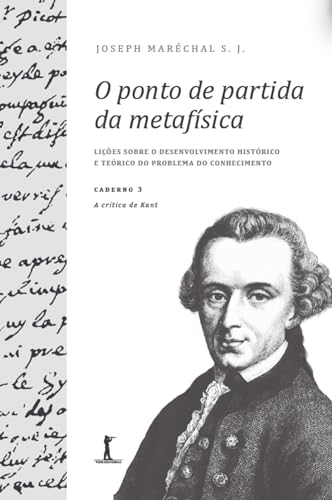 O ponto de partida da metafísica - Caderno 3: A crítica de Kant
Ver na Amazon →
O ponto de partida da metafísica - Caderno 3: A crítica de Kant
Ver na Amazon →
 O ponto de partida da metafísica - Caderno 4: O sistema idealista em Kant e nos pós-kantianos
Ver na Amazon →
O ponto de partida da metafísica - Caderno 4: O sistema idealista em Kant e nos pós-kantianos
Ver na Amazon →
 O ponto de partida da metafísica - Caderno 5: O tomismo diante da filosofia crítica
Ver na Amazon →
O ponto de partida da metafísica - Caderno 5: O tomismo diante da filosofia crítica
Ver na Amazon →← Articles