This is the second of five articles on Joseph Maréchal’s Le point de départ de la métaphysique (The Starting Point of Metaphysics). In the first article, we followed Maréchal’s reading of the classical tradition from the pre-Socratics through Thomas Aquinas, showing how ancient and medieval thought largely assumed a direct cognitive contact with being without needing to systematically justify that assumption. In this second article, we turn to Cahier II, in which Maréchal examines the great modern debate between rationalism and empiricism — and shows how both traditions, despite opposing each other on almost every point, ultimately leave the problem of objectivity unresolved and prepare the ground for Kant’s revolutionary critique.
The Break with the Medieval World
The transition from the Middle Ages to the modern period in philosophy is not simply a matter of chronology. It represents a fundamental shift in the starting point of philosophical inquiry. Where medieval philosophy typically began with being — with the structures of reality as given to a mind that participates in the divine — modern philosophy begins with the thinking subject and asks whether, and on what conditions, that subject can reach reality at all.
The catalyst for this shift was, of course, René Descartes (1596–1650). But Maréchal is careful to show that Descartes does not simply invent the modern problem from nothing. The seeds of doubt about the reliability of sense perception and the possibility of a comprehensive and certain science of nature were already present in late medieval nominalism — in the work of William of Ockham and his successors, who severed the connection between universal concepts and real essences in the external world. If universals are merely names (nomina) rather than real features of things, then the gap between thought and reality was already open before Descartes arrived to widen it into a chasm.
Descartes: The Methodical Turn Inward
Descartes’s methodic doubt is one of the most famous philosophical moves in history. By systematically suspending assent to everything that admits even the slightest possibility of error — the senses, mathematical intuitions, even the conviction that a world exists outside the mind — Descartes arrives at the one certainty that cannot be doubted: cogito ergo sum, I think, therefore I am. The thinking subject, the res cogitans, is the bedrock of the new philosophy.
The consequences for epistemology are profound. By rebuilding knowledge from the inside out — starting from the indubitability of the cogito and reconstructing the external world by means of the veracity of God — Descartes establishes a model in which the primary datum is not being but representation. The mind does not first encounter the world; it first encounters its own ideas. The world must then be inferred or proved.
For Maréchal, this is the decisive break. Descartes does not solve the problem of objectivity — he creates it in its modern form. Once ideas are taken as the immediate objects of the mind, the question of their correspondence to reality becomes unavoidable and urgent. Descartes’s own solution — appealing to the veracity of a non-deceiving God as guarantor of the correspondence between clear and distinct ideas and reality — was widely perceived, even by his contemporaries, as circular: the proof of God’s existence already presupposes the reliability of the clear and distinct ideas it was supposed to guarantee.
Maréchal also emphasizes Descartes’s doctrine of innate ideas as a central feature of his rationalism. For Descartes, the ideas of God, the self, and mathematical essences are not derived from experience; they are implanted in the mind by God and are known with perfect clarity. This doctrine will become a target for the empiricist tradition.
Malebranche and Spinoza: Rationalism Radicalized
Nicolas Malebranche (1638–1715) and Baruch Spinoza (1632–1677) represent two directions in which the Cartesian legacy could be radicalized.
Malebranche took the doctrine of divine guarantee to its extreme in occasionalism: the mind knows things not by receiving their forms (as in Aristotelian epistemology) and not even by having innate ideas that correspond to them, but by seeing all things in God. The ideas by which we know are literally in the divine intellect, which the human mind contemplates. This position dissolves the problem of the correspondence between idea and reality by making the divine intellect the common ground of both — but at the cost of eliminating the proper cognitive activity of the finite intellect entirely.
Spinoza offered a more geometrical rationalism. For Spinoza, there is ultimately only one substance — Deus sive Natura, God or Nature — and human minds are modes of the attribute of Thought within this single infinite substance. Knowledge advances from the confused and fragmentary (imagination and sense) through rational inference to scientia intuitiva — a direct intellectual intuition of the eternal essences of things under the aspect of eternity (sub specie aeternitatis). At the highest level, the human intellect literally participates in God’s self-knowledge.
Maréchal is appreciative of the seriousness with which both thinkers grapple with the problem of knowledge, but notes that both solutions effectively absorb the finite mind into the infinite, leaving no account of how a genuinely finite intellect — embodied, temporal, limited — can have objectively valid knowledge. The rationalist tradition, in all its forms, tends toward a kind of intellectualist monism that is compelling in its internal consistency but remote from the actual conditions of human cognition.
Leibniz: Pre-established Harmony and the Monadology
Gottfried Wilhelm Leibniz (1646–1716) represents perhaps the most elegant form of rationalist epistemology. For Leibniz, reality consists of simple, unextended, spiritual substances called monads. Each monad is a self-contained center of perception and appetition, with no real causal interaction with other monads: the apparent correspondence between mind and world, and between different minds, is explained by God’s pre-established harmony, whereby each monad’s internal development perfectly mirrors the development of every other monad, without any actual exchange.
The epistemological implications are significant. For Leibniz, truth is ultimately a matter of the analysis of ideas: a proposition is true if the predicate is contained in the subject, and in the case of necessary truths (mathematics, logic, metaphysics), this containment is explicit and demonstrable by pure reason alone. Contingent truths — truths about the actual world — are also, in principle, analytically contained in the concept of each monad, but the analysis would require an infinite number of steps and so is available only to God’s infinite intellect.
Leibniz thus preserves the rationalist confidence in the power of reason while introducing a more nuanced account of contingent truth. But Maréchal points out that the doctrine of pre-established harmony renders the correspondence between thought and reality once again a matter of divine arrangement rather than an intrinsic feature of the cognitive act. The mind does not genuinely reach out to being; it unfolds its own inner contents in perfect parallel with being, thanks to God’s original decree.
Locke: The Empiricist Critique Begins
John Locke (1632–1704) launched a decisive attack on the rationalist theory of innate ideas. In his Essay Concerning Human Understanding, Locke argued that the mind at birth is a blank slate (tabula rasa): there are no ideas present in the mind prior to experience. All our ideas — both simple and complex — are ultimately derived from either sensation (the external senses) or reflection (the mind’s observation of its own operations).
This empiricist starting point has radical consequences. If all knowledge is derived from experience, then knowledge claims must be disciplined by experience, and any claim that goes beyond what experience can support must be regarded with suspicion. For Locke, this includes much of traditional metaphysics: we have no clear and distinct idea of substance itself — only of its qualities; we cannot know the inner nature of things, only their observable properties.
Yet Locke is not a thoroughgoing skeptic. He retains a modified form of representational realism: our ideas of primary qualities (extension, figure, motion, number) genuinely resemble the qualities of things as they are in themselves, even if our ideas of secondary qualities (colors, sounds, tastes) do not. And he believes in the intuitive certainty of our own existence, in the demonstrative certainty of God’s existence, and in the sensitive knowledge of the external world. But the criteria for these distinctions are not fully secure, as Berkeley and Hume will show.
Berkeley: From Empiricism to Idealism
George Berkeley (1685–1753) accepted Locke’s empiricist premises and drew from them a conclusion that Locke would have resisted: if all we know are ideas, and if ideas are by definition mental, then there is no coherent sense in which primary qualities could “resemble” mind-independent material things, because we could never step outside our ideas to compare them with their supposed originals. The distinction between primary and secondary qualities collapses: all qualities are equally mind-dependent.
Berkeley’s famous formula — esse est percipi, to be is to be perceived — follows from this argument. Material substance, as something existing independently of any mind, is not only unknown but literally inconceivable: when we try to conceive of a tree existing without being perceived by any mind, we find that we are simply conceiving of ourselves perceiving it. What exists are minds (spirits) and their ideas; the apparent regularity and coherence of the sensible world is maintained by God, the infinite spirit who continuously perceives all things and produces in finite minds orderly sequences of ideas according to the “language of nature.”
For Maréchal, Berkeley’s position represents a decisive step toward the crisis of objectivity. The external world — the very thing that Aristotelian epistemology postulated as the source of intelligible form — has been dissolved into a construction within experience. What remains is a world of ideas, organized by God, but no longer a world of real things in which the mind participates through abstraction.
Hume: The Dissolution of Rational Necessity
David Hume (1711–1776) carried empiricist analysis to its most radical conclusion — and in doing so, produced the crisis that, by his own famous admission, interrupted Kant’s “dogmatic slumber.” If Berkeley showed that we cannot step outside experience to verify the existence of matter, Hume showed that we cannot even find within experience the rational necessity that our most important knowledge claims presuppose.
Hume’s analysis proceeds in two stages. First, following Locke and Berkeley, he insists that all meaningful ideas are derived from prior sensory impressions. Second, he points out that the concept of necessary connection — the concept that lies at the heart of causation, and therefore of natural science — has no corresponding impression. When we observe a billiard ball striking another, we see one event followed by another: but we never see the necessity of the sequence, the compelling power that makes the second event have to follow from the first. The idea of necessary connection is therefore not derived from any impression; it is a habit of the imagination, formed by the repeated observation of constant conjunctions.
The implications are devastating. All of our supposed knowledge of causal laws — and therefore all of natural science insofar as it claims to describe necessary connections in nature — is revealed to rest not on rational insight but on custom and habit. We do not know that the sun will rise tomorrow; we merely expect it, on the basis of past experience and ingrained habit.
Hume extends this corrosive analysis to the concept of the self (no impression corresponds to a persisting, identical self — only a “bundle of perceptions”), to the concept of external substance (similarly ungrounded), and to the traditional arguments for God’s existence. The result is a thoroughgoing skepticism about the pretensions of metaphysics — a skepticism that Hume himself accepted with characteristic equanimity, retreating to the consolations of custom and sentiment.
The Problem of Objectivity: Both Traditions Fail
Maréchal’s central thesis in Cahier II is that rationalism and empiricism, despite their profound opposition, both fail to ground the objective validity of knowledge — and for structurally parallel reasons.
Rationalism begins with the certainty of the thinking subject and tries to infer or guarantee the correspondence between thought and reality through some form of divine mediation (Descartes’s veracity of God, Malebranche’s vision in God, Leibniz’s pre-established harmony). But in each case, the correspondence is externally imposed rather than intrinsically demonstrated: it remains a brute metaphysical fact that the mind corresponds to reality, not a truth that can be read off from the structure of the cognitive act itself.
Empiricism begins with the testimony of experience and tries to build knowledge from the ground up. But by limiting the scope of genuine knowledge to what experience can directly verify, it cuts off the very possibility of knowing the necessary and universal structures that science and metaphysics require. When Hume draws the final conclusion — that even causal necessity is beyond experience’s reach — the skeptical abyss opens fully.
What is needed, and what neither tradition has provided, is an account of how the cognitive act is intrinsically structured in such a way that it reaches genuine, necessary, objective truth — not through external guarantee but through its own constitutive conditions. This is precisely the problem that Kant will attempt to solve — and whose solution Maréchal will both accept and transcend.
Transition to Book III
Hume’s skepticism is not merely a philosophical position to be refuted; it is, for Maréchal (following Kant), a diagnostic achievement. It reveals that the naive confidence of dogmatic metaphysics — the assumption that concepts simply apply to reality without asking why they do so — cannot be sustained. Philosophy must become critical: it must interrogate the conditions of its own possibility before claiming to know anything.
In Cahier III, Maréchal provides his most detailed examination of the work that attempted to answer Hume’s challenge once and for all: Kant’s Critique of Pure Reason. With great philosophical sympathy and rigorous scholarship, Maréchal walks through the Transcendental Aesthetic, the Transcendental Analytic, and the Transcendental Dialectic — and then asks whether Kant’s own conclusions are as final as Kant believed. The answer, as we shall see, turns on a question that Kant himself raised but refused to answer: what is the meaning of the mind’s restless drive toward the Unconditioned?
Recommended Books:
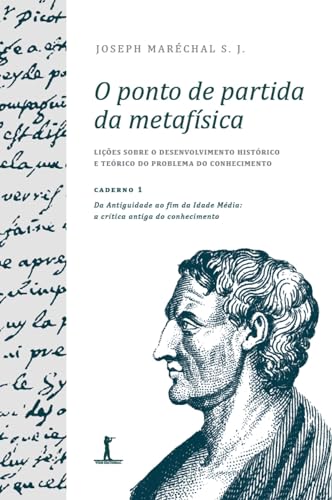 O ponto de partida da metafísica - Caderno 1: Da Antiguidade ao fim da Idade Média: a crítica antiga do conhecimento
Ver na Amazon →
O ponto de partida da metafísica - Caderno 1: Da Antiguidade ao fim da Idade Média: a crítica antiga do conhecimento
Ver na Amazon →
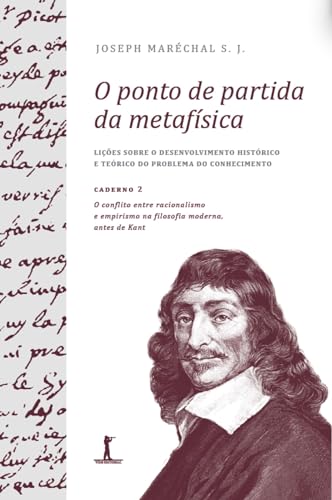 O ponto de partida da metafísica - Caderno 2: O conflito entre racionalismo e empirismo na filosofia moderna, antes de Kant
Ver na Amazon →
O ponto de partida da metafísica - Caderno 2: O conflito entre racionalismo e empirismo na filosofia moderna, antes de Kant
Ver na Amazon →
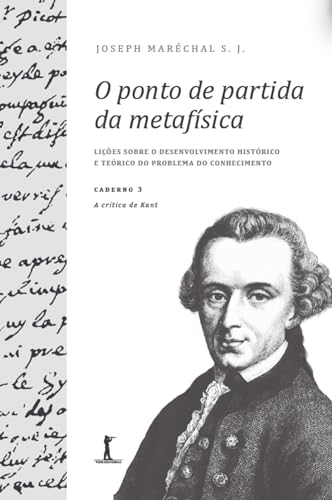 O ponto de partida da metafísica - Caderno 3: A crítica de Kant
Ver na Amazon →
O ponto de partida da metafísica - Caderno 3: A crítica de Kant
Ver na Amazon →
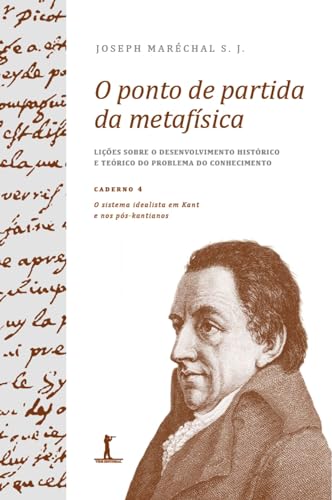 O ponto de partida da metafísica - Caderno 4: O sistema idealista em Kant e nos pós-kantianos
Ver na Amazon →
O ponto de partida da metafísica - Caderno 4: O sistema idealista em Kant e nos pós-kantianos
Ver na Amazon →
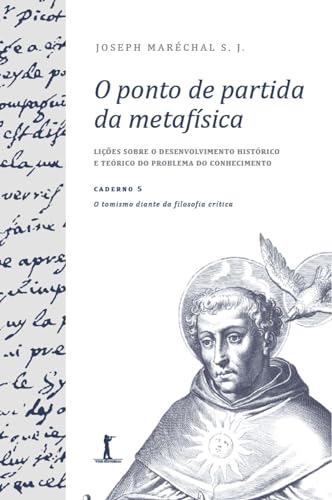 O ponto de partida da metafísica - Caderno 5: O tomismo diante da filosofia crítica
Ver na Amazon →
O ponto de partida da metafísica - Caderno 5: O tomismo diante da filosofia crítica
Ver na Amazon →← Articles