This is the first of five articles dedicated to Joseph Maréchal’s monumental work Le point de départ de la métaphysique (The Starting Point of Metaphysics), published in five notebooks (cahiers) between 1922 and 1947. Each article follows one cahier, tracing Maréchal’s ambitious project: to demonstrate, through a rigorous historical and critical method, that a genuine metaphysics of being is not only possible after Kant but is in fact demanded by the very structure of human knowledge. This first article covers Cahier I, which examines the classical tradition from ancient Greece through the end of medieval Scholasticism.
Who Was Joseph Maréchal?
Joseph Maréchal (1878–1944) was a Belgian Jesuit philosopher and psychologist, professor at the Faculty of Philosophy at Louvain. Working at the intersection of experimental psychology and speculative philosophy, he was uniquely positioned to ask a question that had haunted Catholic thought since the 18th century: how can Thomistic metaphysics — with its bold claim to know being itself — survive the critical challenge mounted by Immanuel Kant?
Maréchal’s answer was neither a simple rejection of Kant nor a capitulation to Kantian limits. It was something more audacious: a transcendental reading of Thomas Aquinas that would show how the dynamism intrinsic to the act of knowing already implies an openness to Absolute Being. But to reach that conclusion, Maréchal knew he had to proceed historically. The Le point de départ project was, therefore, first and foremost an act of intellectual honesty — a willingness to trace the full arc of the problem before proposing a solution.
Cahier I is where that arc begins.
The Guiding Question of Cahier I
The central question Maréchal poses for the ancient and medieval period is deceptively simple: How did the classical tradition articulate the problem of the objective validity of knowledge? In other words, how did philosophers from Thales to Thomas Aquinas address the question of whether human thought genuinely reaches reality, or merely constructs an internal world of representations with no guaranteed correspondence to what is?
This question may seem anachronistic — a projection of modern anxieties onto a world that, by and large, had not yet felt them. And to some extent that is true. But Maréchal argues that the modern problem of objectivity does not arise from nowhere. It has deep structural roots in the ancient tradition itself, roots that Cahier I sets out to expose with historical precision.
The Pre-Socratics and the Dawning Problem of Knowledge
The pre-Socratics were primarily cosmologists. Their central question was about the arché — the fundamental principle or substance underlying all change. Yet within this cosmological project, epistemological tensions were already present. If everything is in flux, as Heraclitus insisted, then what exactly does the mind grasp when it claims to know something? If being is one and unchanging, as Parmenides maintained, then how do we account for the apparent multiplicity and movement that the senses present to us?
Parmenides is especially significant here. His radical distinction between the way of truth (accessible to reason alone, revealing being as one, eternal, and immovable) and the way of opinion (the deceptive testimony of the senses) introduces for the first time a sharp tension between the knowing subject and the empirical world. For Maréchal, this is not yet the modern problem of objectivity — Parmenides does not doubt that reason reaches being — but it is its distant ancestor. The question of the relationship between thought and reality has been opened.
Plato: The Intelligible World and the Ascent of the Soul
Plato inherits the Parmenidean tension and transforms it into a full philosophical system. For Plato, genuine knowledge (episteme) cannot have sensible particulars as its object, because particulars are always changing and therefore cannot be the objects of stable, universal truths. True knowledge must concern the Forms (or Ideas) — eternal, immaterial, perfectly determinate entities that particular things merely participate in imperfectly.
This commitment to the intelligible world solves the Parmenidean problem elegantly: reason does grasp true being, but that being is not the sensible world. The famous Allegory of the Cave dramatizes the ascent from opinion about shadows (sensible appearances) to knowledge of the Forms, culminating in the contemplation of the Form of the Good — the supreme principle that illuminates all others.
For Maréchal, Platonism represents an authentic recognition that knowledge involves a movement of the mind toward something that transcends the immediately given. The eros of the intellect toward the intelligible — the desire to ascend from the Cave — anticipates in important ways what Maréchal will later call the dynamism of the intellect toward Absolute Being. However, Plato’s solution carries a price: it tends to sever the knowing mind from the empirical world rather than showing how the mind can know being through sensible experience. This lacuna will be addressed by Aristotle.
Aristotle: Hylomorphism and the Structure of Knowledge
If Plato represents the flight from matter to form, Aristotle represents the return to the concrete world — not to abandon the intelligible, but to discover it within the sensible. This is the significance of Aristotle’s hylomorphism: every sensible substance is a composite of matter (hyle) and form (morphe), and the form is precisely what the intellect grasps when it knows.
The Aristotelian epistemology developed principally in De Anima is built around three key concepts that Maréchal analyzes with great care.
The first is the intelligible form. When the intellect knows a thing, it does not receive the matter of the thing (otherwise, digesting bread would make us into bread), but only the intelligible form — that which makes the thing the kind of thing it is. The intellect becomes, in a sense, the form of the known thing without its matter. This is Aristotle’s famous formula: the intellect is “the place of forms.”
The second is the agent intellect (intellectus agens). Since sensible objects are only potentially intelligible (their forms are embedded in matter), something must actualize that potentiality — must abstract the intelligible form from the material conditions and render it actually intelligible. This is the function of the agent intellect: it is the active, illuminating principle within the soul that performs the abstraction. Maréchal notes the remarkable parallel with Plato’s notion of intellectual illumination, but insists on the crucial difference: for Aristotle, the light of the agent intellect operates immanently within the human soul, not from a transcendent divine source (as in later Neoplatonism and Augustine).
The third is the return to the phantasm (conversio ad phantasma — a Latin formulation coined by Thomas Aquinas, Summa Theologiae I, q.84, a.7, to articulate an Aristotelian principle from De Anima III.7). For Aristotle, and crucially for Aquinas, the intellect does not know the intelligible form in isolation from sensible experience. Every act of intellectual knowledge involves a return to the sensible image (phantasm) from which the form was abstracted. This means that human intellectual knowledge is always bound to sensible experience — the intellect is not a pure Platonic spectator of a realm beyond matter, but the highest form of a being that is essentially embodied.
This epistemological structure — abstraction of form from the sensible, operation of the agent intellect, return to the phantasm — is, for Maréchal, the decisive achievement of ancient philosophy. It provides the framework within which the problem of objectivity can be addressed without either Platonic flight from the sensible or empiricist reduction to mere sensation.
Neoplatonism and Patristics: The Question of Participation and Illumination
Between Aristotle and Aquinas stands a long tradition that cannot be ignored. Maréchal gives careful attention to Neoplatonism — principally Plotinus — and to its transformation in Christian patristic thought.
For Plotinus, all reality flows from the absolutely simple One through a process of emanation: from the One proceeds Nous (Intellect), from Nous proceeds Soul, and from Soul proceeds the material world. Human knowing is, at its deepest level, the soul’s return toward its source — a movement of epistrophe (return) that mirrors the outward movement of emanation. The intellect knows because it participates in the divine Nous; the highest knowledge is the mystical union of the soul with the One that transcends thought altogether.
Augustine absorbs Neoplatonic illuminationism into a Christian framework. For Augustine, the human mind cannot attain truth through its own powers alone; it requires the illumination of the divine Word, the eternal Truth in whom all the eternal reasons (rationes aeternae) of things subsist. When we grasp a mathematical truth or a moral principle, we are in contact, however dimly, with the divine light.
Maréchal appreciates the genuine insight in this tradition: it recognizes that human knowing is not self-sufficient, that it reaches beyond itself toward a transcendent ground. But he also notes the ambiguity it introduces: if the mind knows only because it is directly illuminated by the divine, what becomes of the proper causality of the intellect itself? This tension will be resolved differently by different medieval thinkers, and most decisively by Aquinas.
Thomas Aquinas: Synthesis and the Act of Being
The Scholasticism of the high Middle Ages — above all the work of Thomas Aquinas — represents for Maréchal the high point of classical epistemology. Aquinas achieves a synthesis that preserves the strengths of both the Aristotelian tradition (the immanent operation of the human intellect, abstraction from sensible experience) and the Augustinian tradition (the orientation of the intellect toward truth itself), while avoiding the weaknesses of each.
The key to Aquinas’s synthesis is his doctrine of the act of being (esse). For Aquinas, the most fundamental metaphysical act is not essence (what a thing is) but existence (that a thing is). Being in its fullest sense is esse — the act of existing — and God alone is pure esse, identical with his own act of being. All creatures have being only by participation: their essence is really distinct from their existence, which they receive as a gift.
This metaphysical doctrine has direct epistemological implications. When the human intellect makes a judgment — affirming that this is the case — it does not merely combine concepts. In the act of judgment, the intellect returns to the real order, to the esse of the thing known. Judgment is the moment in which the mind comes into contact with being as being, not merely with essence as essence. This is why, for Aquinas (and for Maréchal following him), the judgment is the privileged locus of metaphysics: it is in the affirmative act “S is P” that the intellect grasps the esse that no mere concept can contain.
For Maréchal, this is what the classical tradition achieved and what remained to be defended against the modern challenge. The Scholastic tradition had, implicitly at least, the resources to ground the objective validity of knowledge: the agent intellect abstracts real intelligible forms from real sensible things, and the act of judgment returns the intellect to the real being of those things. What remained open — what the modern period would force into explicit crisis — was the question of how this can be systematically justified in the face of the critical challenge that asks: how do we know that our representations correspond to reality?
What the Ancient Tradition Achieved — and Left Open
Maréchal’s reading of the classical tradition is neither nostalgic nor uncritical. He acknowledges that the great thinkers of antiquity and the Middle Ages did not pose the problem of knowledge in the same terms as Descartes or Kant. They largely assumed a naive realism — a direct contact between mind and world — that modern philosophy would subject to withering scrutiny.
Yet this does not mean their work was naive in a pejorative sense. The Aristotelian-Thomistic epistemology, in particular, contains the structural elements of a sophisticated answer to the modern problem: the real reception of intelligible forms, the active operation of the intellect in abstraction, and the return to esse in judgment. What the tradition lacked was the systematic, reflexive articulation of these elements as a response to the specific challenges of Cartesian doubt, Humean skepticism, and Kantian criticism.
That articulation is the task Maréchal sets for himself in the remaining four Cahiers. Cahier I establishes the tradition worth defending. The following Cahiers will chart the crisis that threatened it and the path through which it can be renewed.
Transition to Book II
The story that Maréchal has traced in Cahier I is one of largely implicit confidence: ancient and medieval thinkers knew that the intellect reaches being, but they had not been forced to justify that claim at the level of systematic rigor demanded by modern epistemology. That age of confidence was about to end.
In Cahier II, Maréchal turns to the great modern debate between rationalism and empiricism — Descartes, Spinoza, Leibniz on one side; Locke, Berkeley, Hume on the other — and shows how both traditions, despite their apparent opposition, conspire to produce the critical crisis that culminates in Kant’s Critique of Pure Reason. The question of whether human knowledge can reach an objective, mind-independent reality becomes, for the first time, the central problem of philosophy — and the stakes for metaphysics could not be higher.
Recommended Books:
 O ponto de partida da metafísica - Caderno 1: Da Antiguidade ao fim da Idade Média: a crítica antiga do conhecimento
Ver na Amazon →
O ponto de partida da metafísica - Caderno 1: Da Antiguidade ao fim da Idade Média: a crítica antiga do conhecimento
Ver na Amazon →
 O ponto de partida da metafísica - Caderno 2: O conflito entre racionalismo e empirismo na filosofia moderna, antes de Kant
Ver na Amazon →
O ponto de partida da metafísica - Caderno 2: O conflito entre racionalismo e empirismo na filosofia moderna, antes de Kant
Ver na Amazon →
 O ponto de partida da metafísica - Caderno 3: A crítica de Kant
Ver na Amazon →
O ponto de partida da metafísica - Caderno 3: A crítica de Kant
Ver na Amazon →
 O ponto de partida da metafísica - Caderno 4: O sistema idealista em Kant e nos pós-kantianos
Ver na Amazon →
O ponto de partida da metafísica - Caderno 4: O sistema idealista em Kant e nos pós-kantianos
Ver na Amazon →
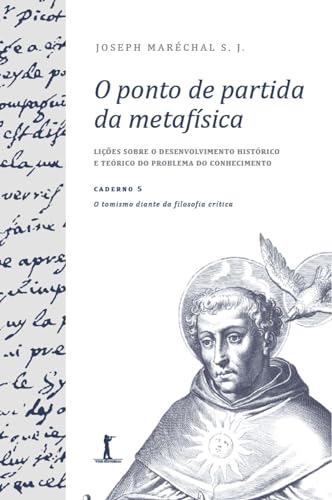 O ponto de partida da metafísica - Caderno 5: O tomismo diante da filosofia crítica
Ver na Amazon →
O ponto de partida da metafísica - Caderno 5: O tomismo diante da filosofia crítica
Ver na Amazon →← Articles